
How the Sun will become a white dwarf
After its giant phases, the Sun will leave a dense, cooling core. Fusion, mass loss and quantum pressure explain how a familiar star becomes a white dwarf.
The Sun’s later life will leave a white dwarf: a small, dense stellar remnant that gradually cools. Reaching that state involves changes in where nuclear fusion occurs, an enormous expansion of the star’s outer layers and the loss of much of that material. It is a sequence of physical changes over billions of years, rather than a single moment when a flame goes out.
What keeps the Sun shining now?

Deep inside the Sun, nuclear fusion converts hydrogen into helium and releases energy. The hot interior supplies pressure that supports the star against the inward pull of gravity. This long-lived hydrogen-fusing phase is called the main sequence.
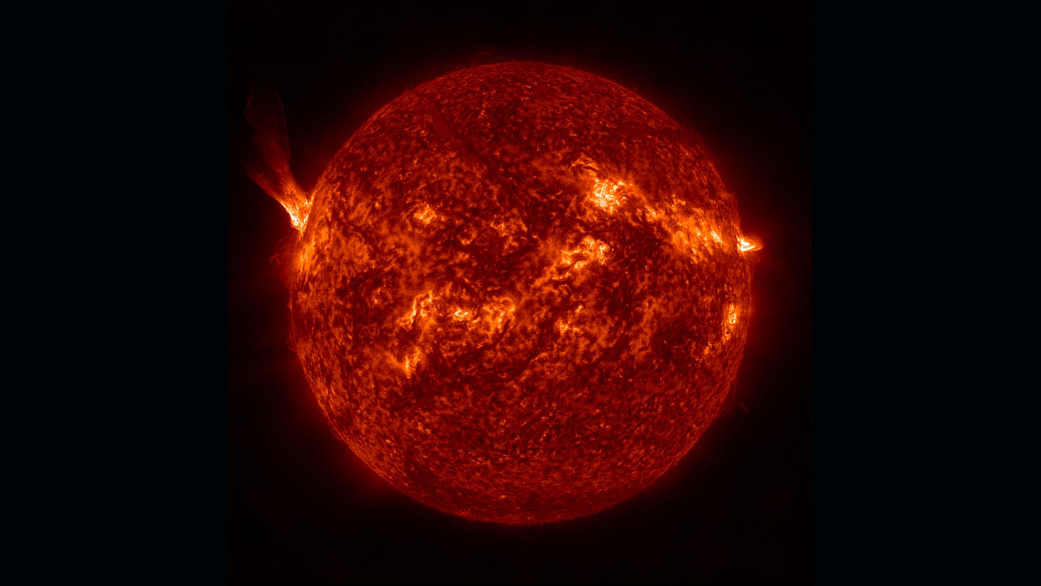
The phrase “running out of fuel” needs a location. The critical change is the depletion of hydrogen in the core; hydrogen still exists elsewhere in the star. Solar flares and eruptions, such as the activity in the small SDO image, occur in the Sun’s atmosphere. They are not evidence that the core has reached the end of this stage.
Why the core contracts while the outside expands

When core hydrogen fusion can no longer maintain the previous balance, the core contracts and heats up. Hydrogen fusion can continue in a shell around it. The star’s outer layers expand, producing a red giant. The core and the visible outer surface therefore do not have to change size or temperature in the same direction.
Later, the contracting core becomes hot enough for helium fusion, which builds heavier nuclei including carbon. The Sun’s mass limits how far this progression can go: it will not become hot enough to sustain carbon fusion in its core. The evolutionary sequence includes more than one giant stage, simplified in the illustration.
What happens to the outer layers?
During the later giant phases, the star becomes unstable and loses outer material. Eventually the hot core is exposed. Ejected gas around such a remnant can form a planetary nebula, a historical name for a stellar gas cloud that does not mean the cloud is a planet.
The remnant and the surrounding gas are different parts of the original star. The white dwarf is the surviving compact core, while the expelled material moves outward. This is the expected route for the Sun, rather than the core-collapse supernova route associated with much more massive stars.
What stops a white dwarf collapsing?
A white dwarf no longer maintains the Sun’s steady core fusion. Instead, electrons packed into its dense matter provide electron degeneracy pressure. Quantum rules restrict the states identical electrons can occupy. Compressing them further encounters a resistance that does not depend on keeping hydrogen fusion running.
This quantum support lets a compact remnant persist while it radiates stored heat and cools. A typical white dwarf is roughly Earth-sized despite containing a substantial fraction of a star’s mass. “Dwarf” describes its small physical size, not planet-like density.
We can observe the remnants already

The faint point below and left of Sirius A in the Hubble observation is Sirius B, a white dwarf. Sirius A was deliberately overexposed to reveal its much fainter companion. The bright spikes and rings are produced by the imaging system; their apparent widths do not measure either star’s diameter.
Other stars provide examples of evolutionary stages, while stellar models connect those observations with nuclear physics and the properties of the Sun. We are not watching the future Sun directly. Estimates put the end of its main-sequence phase roughly five billion years ahead, with the giant stages and remnant formation following. These are model-based timescales, not an exact appointment for a sudden event.
Watch the short source explanation

A 2025 expert video introduces the broad sequence. The overview compresses several phases: core hydrogen depletion comes before the later helium-fusing stages, and the eventual white dwarf glows from remaining heat. The detailed steps above explain what connects those milestones.
Join the conversation