
Why the Moon looks bigger near the horizon
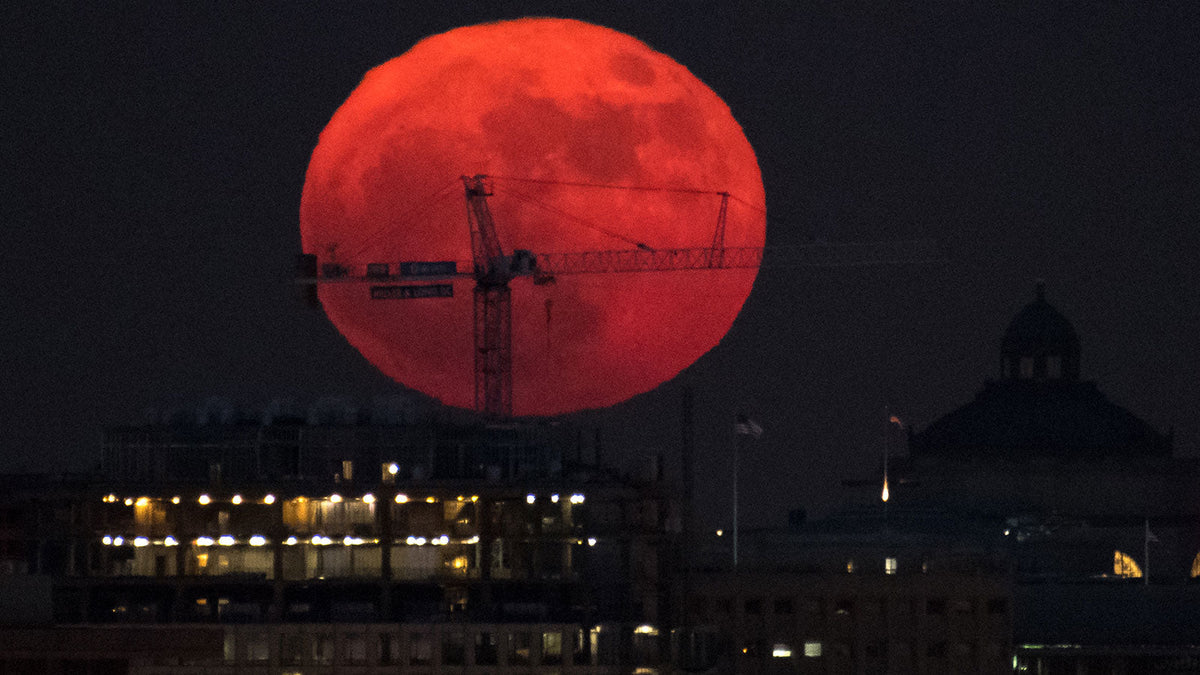
A rising Moon can look enormous without growing wider in a fixed-zoom photograph. Perception, atmospheric effects and orbital distance each play different roles.
A Moon rising above rooftops can seem much larger than the same Moon later in the night. The striking impression is called the Moon illusion: looking larger does not necessarily mean occupying more of the sky.

Measure the width with a camera
Photograph the Moon low in the sky and again when it is higher, using the same camera and focal length or zoom setting. Compare the lunar disks at the same image scale, without enlarging either picture separately. Measure horizontally, from one edge to the other.
The widths should be nearly the same, despite a different impression outdoors. Small geometric changes remain possible as Earth's rotation changes your distance from the Moon. Air near the horizon can also squash the disk vertically. The photographic comparison and procedure show why width is the useful test.

Why perception changes is still unsettled
Proposed explanations involve how vision interprets distance and surrounding scenery. Buildings or trees can provide size and distance cues, but foreground comparison does not fully account for the effect. An exact, complete explanation remains elusive. The Moon-illusion explainer describes both the evidence and the limits of these ideas.
Air changes colour and shape
Near the horizon, moonlight passes through more atmosphere. More short, blue wavelengths scatter away, so the disk can look yellow, orange or red. Refraction can flatten it vertically. These optical changes are real, but they do not explain the dramatic increase in perceived width.
A supermoon is a separate size change
The Moon's orbit is elliptical. It genuinely occupies a larger angle when closer to Earth, near perigee, than when farther away, near apogee. A full Moon near perigee is often called a supermoon.
The maximum comparison can reach about 14% in apparent diameter between perigee and apogee. That is a comparison with the farthest Moon, not an average full Moon. This orbital explanation and size comparison concerns changing distance over the orbit; the horizon illusion concerns how a Moon is perceived during a night.
Join the conversation