
What gives Saturn’s north-pole jet its six sides?
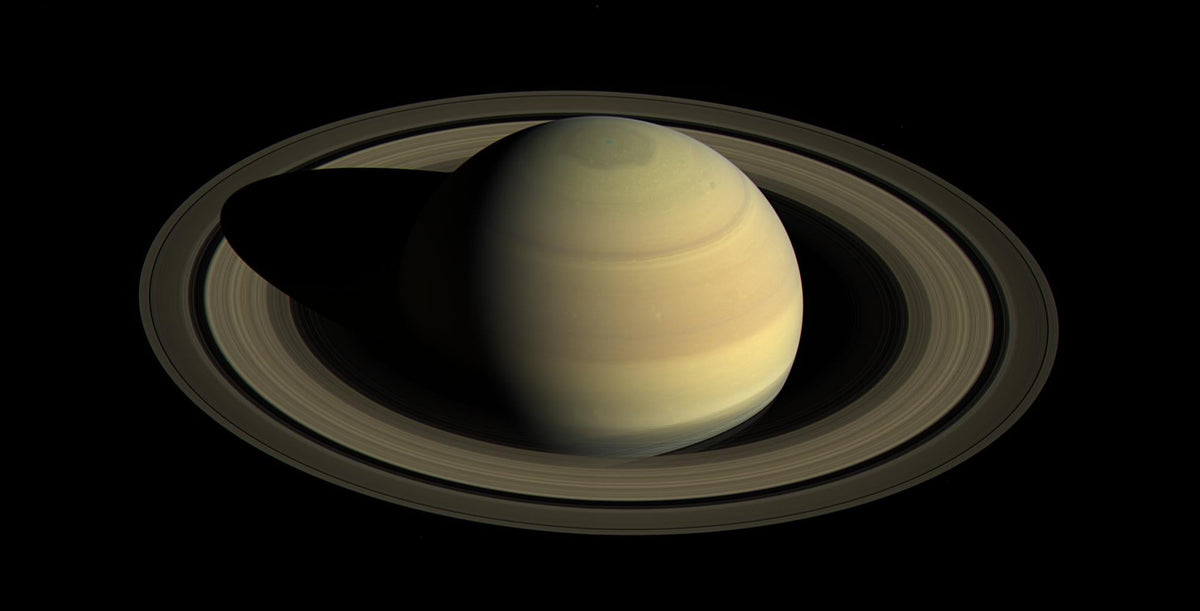
Clouds race around Saturn’s north pole inside a pattern that has lasted for decades. Cassini tracked the winds, and experiments show how a rotating jet can take on corners.
Around Saturn’s north pole, an eastward jet stream bends six times and closes back on itself. The wind can reach roughly 500 kilometres per hour, yet the six-sided outline has endured since the Voyager flybys of the early 1980s. Its persistence is a clue to how waves and winds interact on a rapidly rotating planet. NASA’s Cassini mission account
A fast wind can trace a slow-moving pattern

The hexagon spans roughly 30,000 kilometres, more than twice Earth’s diameter. Inside it lies a separate cyclone centered on the pole. Cassini could track clouds in consecutive images to see them travel along the jet, while the corners of the outline drifted slowly in a frame turning with Saturn. The distinction is between the motion of the gas and the motion of the shape it traces. The same corner can persist while different clouds pass through it. Cassini’s observations of the jet and vortex
How Cassini saw it in winter darkness

Saturn takes nearly 30 Earth years to orbit the Sun, so the polar night lasts for years. When the north was dark, Cassini’s infrared spectrometer could use heat escaping from warmer layers as a backlight. Thick clouds blocked some of that emission and appeared dark in the infrared image. The resulting contrast traced the hexagon around the winter pole before sunlight returned and Cassini could make detailed images in reflected light. The 2006 infrared observation
How a rotating jet can grow corners
A narrow jet moves faster than the fluid on either side. That change in speed across the jet is called shear. Small bends can grow by drawing energy from the flow. When the jet wraps around a pole, a wave that fits six bends into one circuit can give it six corners. This is one way researchers explain the link between a continuous moving current and a persistent polygon.
In a laboratory study, Ana Barbosa Aguiar and colleagues spun a cylindrical tank and turned a narrow ring at a different speed from the tank. The ring drove a current in the fluid. By tracking particles in successive images, the team measured how the current settled into polygonal patterns under different conditions, including one with six sides. A separate computer study by Rakesh Kumar Yadav and Jeremy Bloxham found that deep convection, driven by rising and sinking fluid, can create large vortices that squeeze a fast jet into a polygon. Both studies show ways a rotating flow can develop corners. Saturn’s observations still leave the depth and source of the disturbance open. The rotating-tank study · The deep-convection study
The color changed while the outline survived

Cassini’s natural-color comparison shows a blue-green interior in June 2013 and a mostly yellow haze in April 2017. Sunlight was increasing as the north approached summer, and the mission team linked the yellowing to the production of haze particles by sunlight-driven chemistry. The hexagon remained visible through that change. Each panel in the clip is its own Cassini sequence, so the four-year change in appearance is a comparison between the panels. NASA’s 2013 and 2017 comparison
In a separate study, Cassini’s infrared spectra revealed a hexagonal boundary around a warm summertime vortex roughly 300 kilometres above the clouds. That suggests the lower pattern may influence the atmosphere far above it. The temperatures at those heights cannot by themselves locate the deeper source of the jet. Hubble later found a distinct ten-sided wave around the south pole, giving researchers another example to compare with the long-lived northern pattern. The Cassini spectroscopy study · Hubble’s south-pole observations
Join the conversation