
Why dust devils leave dark tracks on Mars
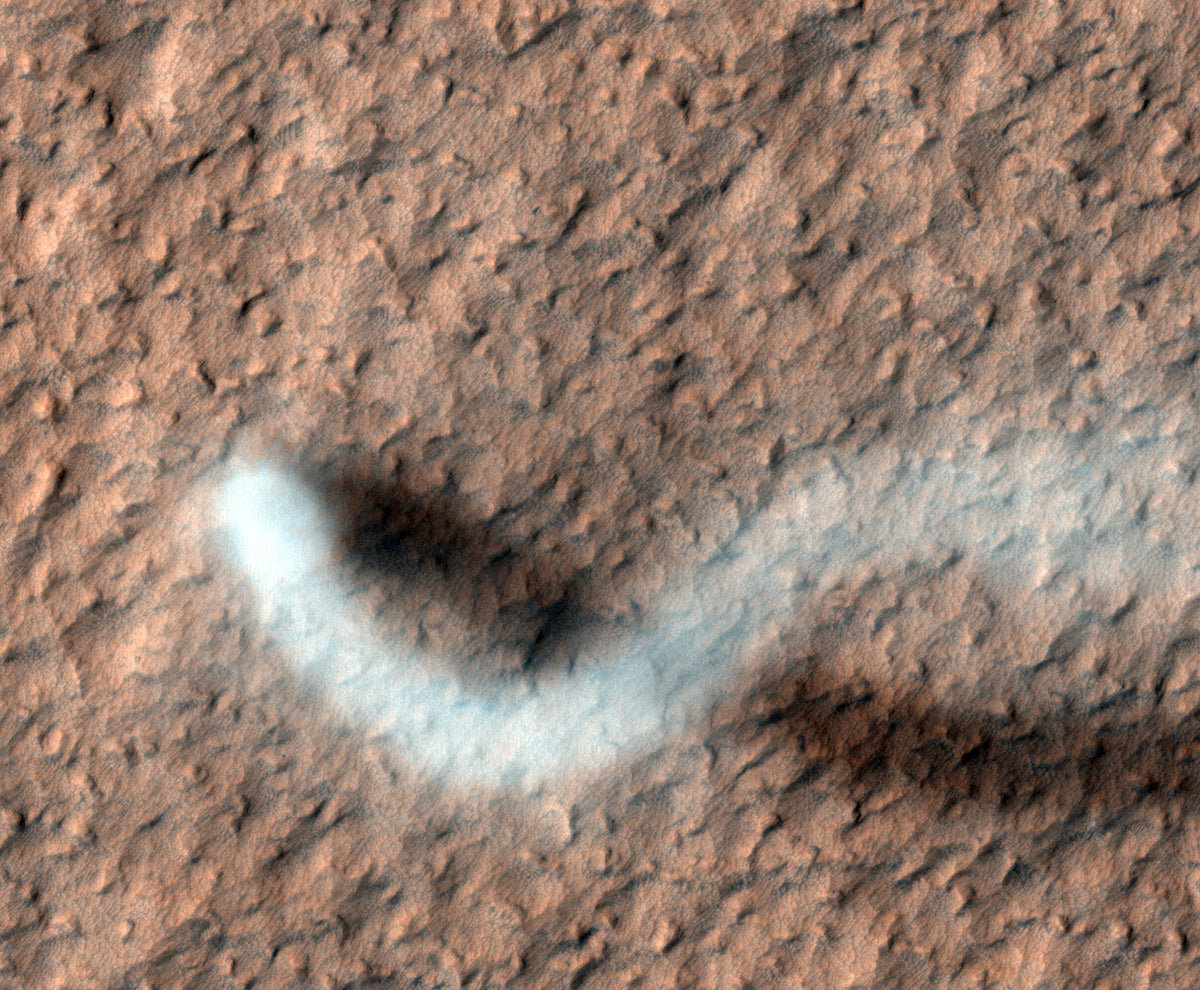
A whirl of dust can pass in minutes, while its trail remains visible from orbit. HiRISE images show how to tell a lasting mark from the moving shadow.
In an orbital image of southern Mars, a pale swirl sits between two dark marks. One mark is the shadow of dust still in the air. The other is a track on the ground, left as the whirlwind moved across the surface. That difference lets researchers tell a passing dust devil from the changes it leaves behind.
A bright plume and two different dark marks

The HiRISE camera’s June 2009 image catches all three features together: the pale vortex near the center, its shadow toward the upper left and a dark surface track toward the lower right. The shadow moves with the dust column and disappears when it dissipates. The surface track can outlast the vortex because the wind has changed the ground’s dusty coating.
What a bent plume can tell us

Daylight warms the ground, which heats the air just above it. Pockets of warm air rise, and local airflow can set the rising column spinning. If the winds near the base lift loose particles, the otherwise invisible vortex becomes a dust devil. A wind higher up can bend the airborne dust away from the direction the base is traveling. In a 2012 HiRISE observation of Amazonis Planitia, researchers used the shadow to estimate that the plume reached more than 800 meters high. The curve in that plume is not the path the vortex traveled.
How the wind makes a dark track

Fine dust often forms a bright coating over darker, coarser material. When a vortex lifts or redistributes some of that dust, the ground along its path reflects less light than the ground beside it. From orbit, the difference in reflectivity, or albedo, appears as a dark line. The line does not have to be a groove: rearranging a thin coating can make a strong visual mark without carving a trench.
Look at the loops and crossings in the 2020 view of a southern dune field. The HiRISE team interpreted the dark marks as paths left when vortices moved off the warmer dunes onto the brighter plains. Where one mark clearly cuts across another, the overlap can establish which passage came later. Other terrain can give a different result. At the Amazonis site in the cover image, HiRISE observed bright tracks; the team proposed that disturbing a thick dust deposit could brighten the surface there. The contrast depends on what the wind encounters, and the bright-track mechanism is less certain.
Why a map of tracks is not a census of whirlwinds
Tracks stay visible longer than the whirlwinds themselves, but some fade within months and some vortices leave no visible track at all. A 2025 study of HiRISE observations from 2014 to 2018 searched thousands of frames for marks such as straight or looping trails. The authors found tracks in roughly 4% of the images they examined, with more detections in the local summer at higher latitudes. A faint trail or one less than about five meters wide could escape their search, and HiRISE did not image every location equally often.
The result is a map of surviving marks that the camera and survey could detect. Those marks show where winds can disturb the surface and help researchers study how dust moves between the ground and the atmosphere. A blank patch on that map, though, does not establish that no whirlwinds passed through it.
Join the conversation