
Why Triton orbits Neptune backward
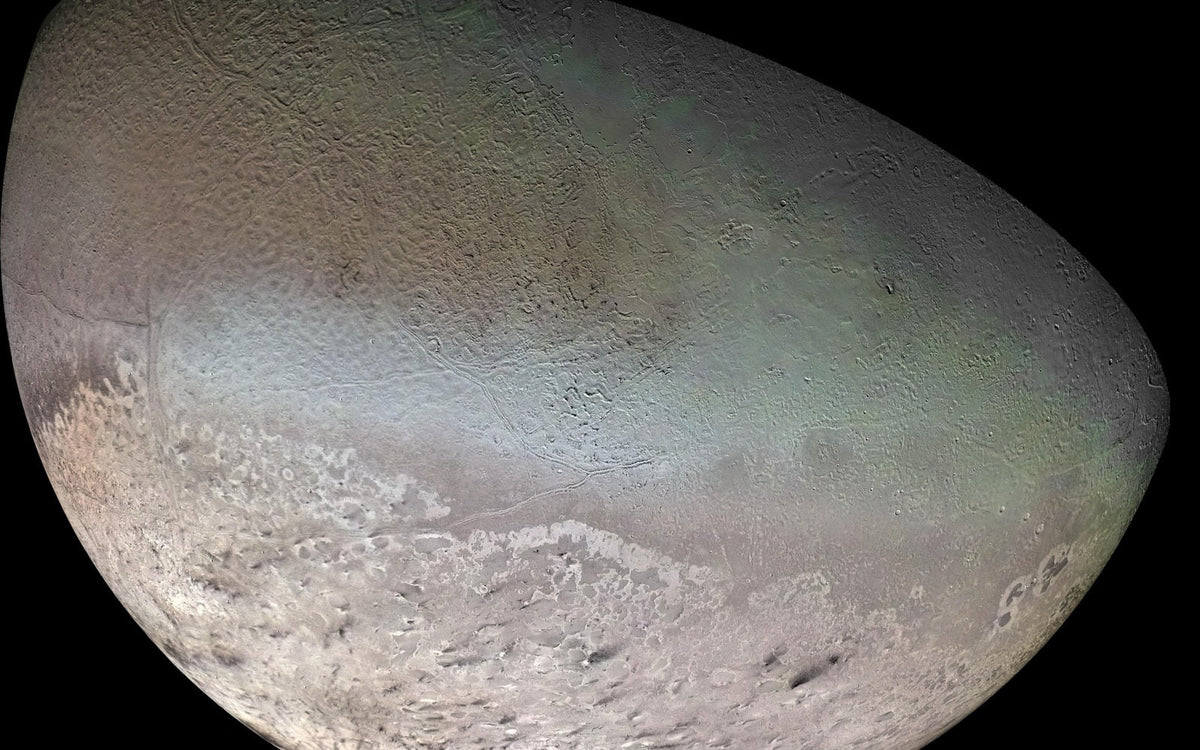
Neptune’s largest moon circles against the planet’s spin. Its tilted orbit points to capture, and a three-body encounter shows how it could have happened.
Triton takes just under six Earth days to circle Neptune, and it goes the opposite way to the planet’s spin. That direction is a clue to where the moon came from. A close encounter with Neptune could have pulled apart a pair of icy worlds and left one of them in orbit. NASA’s Triton overview
The orbit gives away an unusual history

Picture looking down at Neptune from above its north pole. Its close-in regular moons travel in the same sense as the planet spins. Triton goes the other way, a direction astronomers call retrograde. JPL’s orbital solution puts its inclination at about 157 degrees relative to Neptune’s equator. An inclination of 180 degrees would be a perfectly equatorial orbit in reverse. Triton’s path is tilted about 23 degrees from that plane. JPL’s orbital elements
A single frame like Voyager’s approach photo gives a position on the sky. Tracking Triton’s position over many observations and fitting a trajectory gives astronomers its direction and period. The inclination comes from comparing that orbit with the orientation of Neptune’s equator. JPL’s guide to satellite orbits
What that orbit tells us about Triton’s origin

Moons that grow in a disk of material circling a young planet generally inherit the disk’s direction and orbit close to its equator. Triton’s combination of size, tilt and backward motion is strong evidence that it formed elsewhere. The leading picture is an icy body that once orbited the Sun in the outer solar system and later encountered Neptune. The pale terrain and southern polar cap in Voyager’s pictures tell us about the moon’s surface. The orbit is the evidence that points to capture. The original capture study
How Neptune could keep a passing world

In an idealized flyby involving just Neptune and an incoming object, the object speeds up as it falls toward the planet and slows as it climbs away. A body that arrives on an unbound path still has enough orbital energy to leave. A permanent capture needs a way to transfer or dissipate some of that energy.
In 2006, Craig Agnor and Douglas Hamilton simulated encounters between Neptune and binaries, pairs of bodies already orbiting each other. On a close pass, Neptune can pull harder on the nearer member and split the pair. The partners are moving in different directions around their shared center of mass. Depending on their positions and speeds at breakup, one can lose enough orbital energy relative to Neptune to stay bound while the other leaves with more. The direction of the approach can put the captured body on a retrograde orbit from the start. Agnor and Hamilton’s simulations
Why Triton’s orbit is nearly circular today
The successful captures in those simulations typically produced long, eccentric orbits. Triton today stays at almost the same distance from Neptune as it goes around. On a stretched orbit, the planet’s changing pull would have repeatedly flexed the moon. Internal friction could turn some of that orbital energy into heat and gradually shrink and round out the path.
Other moons might have played a part. Raluca Rufu and Robin Canup simulated what would happen if a newly captured Triton crossed a pre-existing satellite system. In some runs, encounters and collisions helped shrink its orbit faster, potentially allowing a distant moon on an orbit like Nereid’s to survive. Those results depend on the assumed masses and paths of the early moons. Astronomers can measure Triton’s present orbit precisely, while the identity of any former partner and the details of the capture remain open. Rufu and Canup’s follow-up study
Join the conversation