
Why Io leaves a glowing footprint on Jupiter
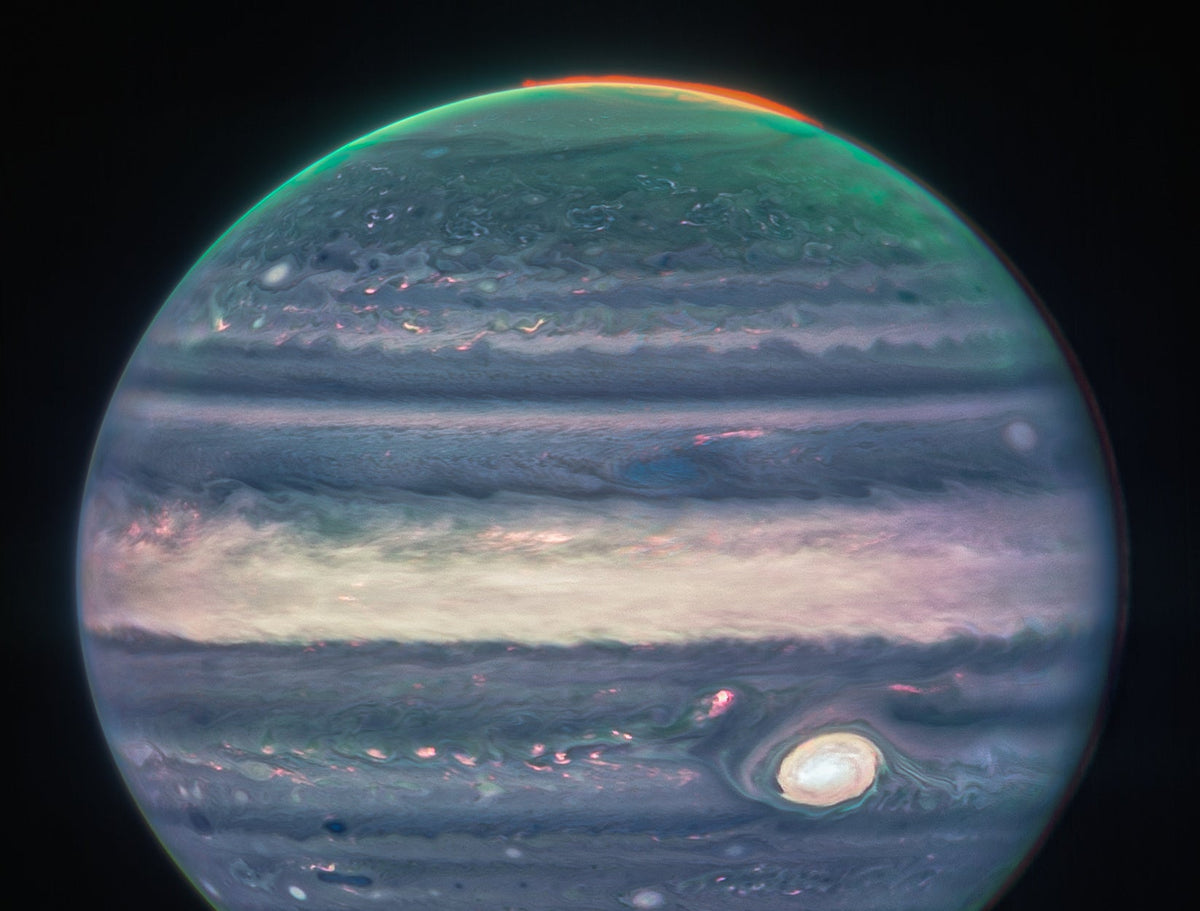
A bright spot near Jupiter’s pole follows the volcanic moon. Hubble mapped the glow, and Juno measured the electrons that help power it.
Io orbits near Jupiter’s equator, yet it leaves a bright spot in the giant planet’s polar skies. The moon never touches Jupiter’s atmosphere. Instead, it disturbs the charged gas flowing past it, and Jupiter’s magnetic field carries that disturbance toward the poles.
A spot apart from the main aurora

In a Hubble ultraviolet image from November 26, 1998, Jupiter’s northern aurora looks like a bright oval. Near the far left edge is a separate bright spot: Io’s footprint. The oval and the spot both come from gas glowing high in Jupiter’s atmosphere, but the spot tracks a particular moon. It shifts as Io orbits, and it can have a fainter trail behind it.
A single image shows where the atmosphere lit up. It takes repeated observations, together with Io’s known orbit and a model of Jupiter’s magnetic field, to work out which feature belongs to the moon. The image also records footprints from Europa and Ganymede. Juno later identified Callisto’s much fainter signature in data from a September 2019 pass.
How the signal gets from Io to Jupiter

Io’s volcanic activity helps supply gas to the space around the moon. Some of that gas becomes ionized: its atoms or molecules lose electrons, forming a mixture of charged particles called plasma. Much of that material forms a broad ring around Jupiter along Io’s orbit. Jupiter’s rotating magnetic field helps sweep the plasma around the planet faster than Io travels, so it flows past the moon.
Io and its surrounding atmosphere disturb that flow. The disturbance travels through the plasma along Jupiter’s magnetic field as Alfvén waves, which are waves in a magnetized plasma. The interaction accelerates electrons. When electrons moving toward Jupiter strike gas in its upper atmosphere, the gas gives off light. That glow is the footprint. The waves can travel toward both hemispheres, so Io can leave a mark in the north and the south.
What the offset tells scientists

The bright spot does not sit exactly where an instantaneous magnetic map would put it. The disturbance takes time to reach Jupiter, and Io and the plasma move while it travels. Researchers used Juno ultraviolet observations from 2016 to 2022 to compare the spot’s position with a model of the magnetic field. The offset helps them estimate travel time and test how well the model describes the space around Jupiter.
Juno also crossed magnetic paths connected to Io’s faint trail. Its instruments measured electrons moving toward the atmosphere and found that they generally carried less energy per unit area and time farther down the trail. This links a feature seen from afar to particles measured on site. The details of how those electrons gain energy are still studied, and Io’s footprint accounts for only a small part of Jupiter’s broader aurora.
Join the conversation