
ALMA uses gas motions to weigh an early-universe black hole
The estimate for W2246-0526 is about 6.5 billion solar masses. It probes the black hole's gravitational surroundings, with important modelling uncertainties.
A study published November 20 in Science Advances uses ALMA observations to estimate that the black hole in the distant quasar W2246-0526 has about 6.5 billion times the Sun's mass. CATA's November 23 account highlights the result as a way to test how astronomers weigh black holes in the early universe.
The galaxy is seen when the universe was about 1.3 billion years old. The new measurement concerns the gravitational effects on surrounding gas, rather than an image of the black hole's boundary.
The coloured image shows emitting gas

The accompanying ALMA composite combines two tracers: carbon monoxide appears orange and singly ionized carbon appears blue. These are assigned display colours. They do not show the galaxy in visible light, and blue versus orange does not indicate gas moving towards versus away from Earth.
A map locates the emission, while a spectrum adds information about motion. Measuring both makes it possible to compare conditions at different distances from the galaxy's centre. The brilliant central patch is emitting material; it should not be interpreted as a photograph of the event horizon.
How a spectrum records motion

Atoms and molecules emit light at characteristic wavelengths. Motion along our line of sight shifts those wavelengths through the Doppler effect. Gas moving towards us shifts its emission towards shorter wavelengths; gas moving away shifts it towards longer wavelengths. A collection of gas with a larger spread of velocities can produce a broader spectral line.
The spectroscopy explanation describes why gas motions can help infer black hole masses. The illustration here compares narrow and broad profiles at equal peak height. It is a conceptual comparison, not a spectrum from this galaxy, and it does not suggest that brightness remained constant in the observations.
There is also a different wavelength shift in this story. Cosmic expansion has stretched W2246-0526's light by a factor of about 5.6, corresponding to a redshift of 4.6. That overall displacement and the smaller spectral differences associated with internal gas motions answer different questions: cosmic epoch and local dynamics.
Separating gravity from an outflow
The accepted author manuscript describes fitting spectra in successive regions around the centre, separating an outflow contribution from the gas's velocity dispersion. That dispersion measures a spread of speeds, rather than requiring the gas to form a neat rotating disc.
The researchers fitted the inward rise in dispersion with a model including the central black hole, the host galaxy's gravity and the telescope's spatial blurring. Both gas tracers gave consistent central mass estimates. Interpreting all broadening as a black hole's pull, without accounting for other components, would miss a central part of this analysis.
The preferred fit gives about 6.5 billion solar masses, with formal errors of roughly 0.6-0.7 billion. The authors warn that these errors may understate systematic uncertainty. Different assumptions and choices of fitted data change the result; the headline number is a model-based estimate.
A gravitational neighbourhood is not an event horizon
The sphere of influence is the region where the black hole's gravity dominates over the surrounding galaxy's contribution. It is not the event horizon, beyond which light cannot escape, and it is not a hard limit where the black hole's gravity suddenly ends.
ALMA's account describes resolving features roughly 700 light-years across. That scale concerns the gas around the nucleus, not the black hole's edge. The team suggests that obscuring dust helps shield nearby gas from intense radiation, preserving tracers that might otherwise become difficult to detect. That is an interpretation to test in other systems.
Why a dusty galaxy is a useful target
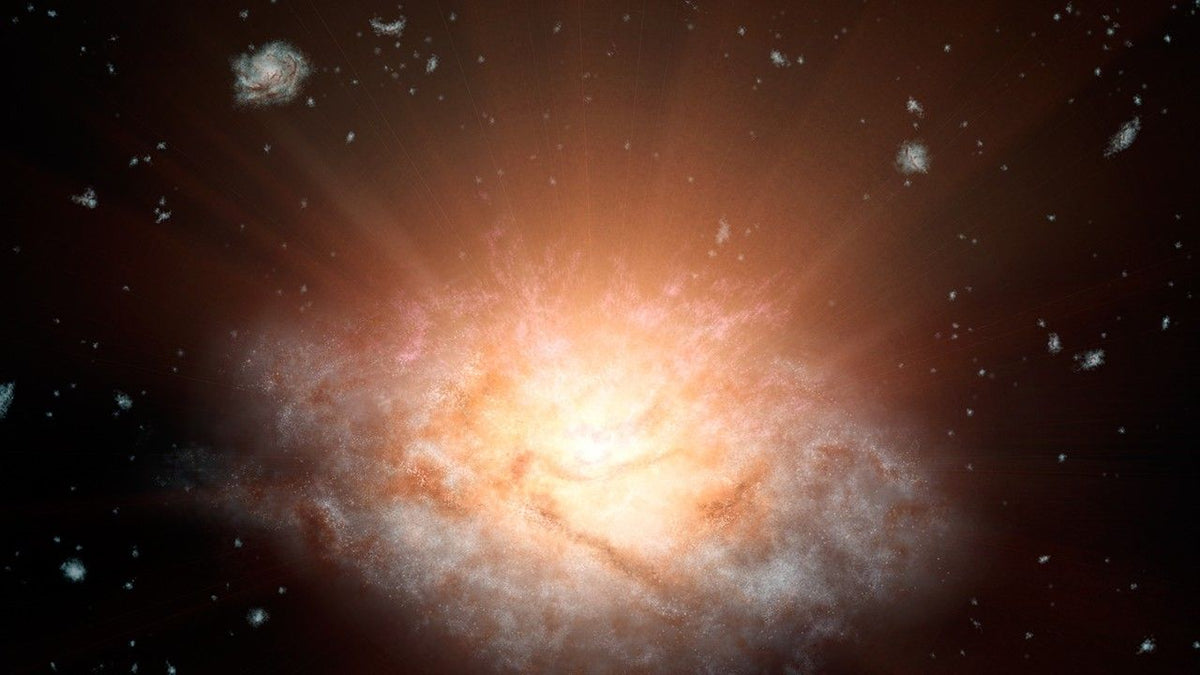
The cover is a professional artist's concept released in 2015, when this object was already known. Its original description explains the energy flow: material falling towards the central black hole heats up and radiates, while surrounding dust absorbs shorter-wavelength light and re-emits energy in the infrared. The artwork illustrates that physical setting; the ALMA gas map supplies observational evidence.
The research circulated as a preprint before its November 2026 journal publication. The significance of the present study is an additional way to check mass estimates that rely on quasar brightness and spectral-line calibrations. A larger sample can test those methods more effectively. One quasar does not establish how every early supermassive black hole formed or grew.
Join the conversation