
NASA targets March 2027 for robotic welding trial on the ISS
JOINS will compare laser and friction stir welding in the space environment. Cameras and returned test pieces will help assess the joints; the trial remains planned.
NASA now lists March 2027 as the estimated date for a robotic welding demonstration on the International Space Station. Its JOining Demonstrations IN-Space (JOINS) page, published November 22, assigns the Lockheed Martin-led payload to Northrop Grumman’s CRS-25 cargo flight. The experiment will test ways to join aluminum and stainless steel in exposed space, a step toward assembling larger structures after launch.
Two ways to make a metal joint

The planned experiment includes laser beam welding and friction stir welding. A laser concentrates light on a small region of metal, heating it until it melts and fuses. The energy can be delivered to a narrow area rather than heating the entire component.
Friction stir welding takes a different route. As NASA’s account of ground-based rocket-tank manufacturing explains, a rotating pin uses friction and pressure to soften metal along a joint. The tool moves through the seam and mechanically mixes the softened material without melting it. “Solid-state” welding therefore means that the workpiece stays below melting, not that it remains rigid while the tool passes.
The illustration compares those process principles. It is not a drawing of the JOINS flight equipment, and it does not imply that the demonstration will weld aluminum directly to stainless steel.
Why use the station’s airlock?
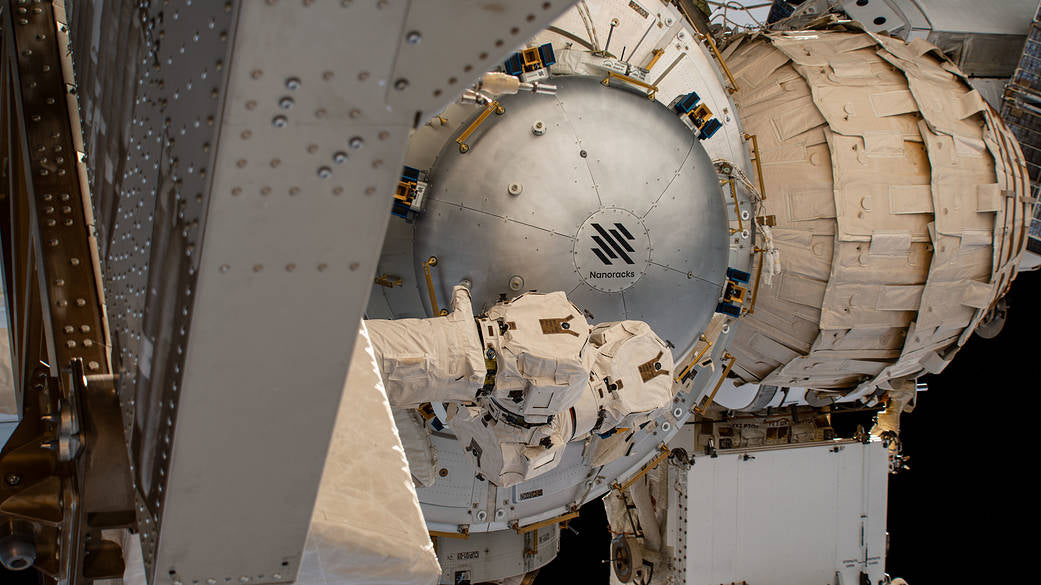
NASA’s 2025 in-space manufacturing catalogue describes JOINS as a module to be integrated with Bishop, exposed to the space environment for joining demonstrations, and followed by the return of test articles to Earth. That sequence lets a controlled experiment experience orbital conditions while remaining connected to the station’s research infrastructure.
Bishop’s design includes tracks for mounting automated payloads, electrical connections and data links. The airlock can move experiments between the station and the outside environment; it is also detachable and can be repositioned by a robotic arm. The photograph above is an archival December 2020 view of Bishop beside the station’s BEAM module, not an image of JOINS operating.
Vacuum, microgravity and changing temperatures can alter heat transfer, material behavior and robotic operations. The flight trial is intended to check whether joining methods work under those combined conditions.
A picture of a weld is only part of the evidence
NASA plans to monitor JOINS with onboard cameras and bring the physical test pieces home months afterward. Images can document the process; returned material allows closer inspection of what it produced.
A separate NASA engineering report published in March 2026 illustrates why process details matter. In a ground-manufacturing investigation, engineers linked weak friction stir welds to welding power outside an optimal range and overly aggressive surface preparation after welding. They used process records, microscopy and mechanical tests to diagnose the problems. Those findings concern a different welding system; they are background evidence for careful validation, not reported JOINS faults.
The dates and the larger goal
The 2025 catalogue anticipated an ISS demonstration in 2026. NASA’s new page gives March 2027 as an estimate, without explaining the schedule change. Its current CRS-25 launch advisory targets no earlier than November 29, 2026, at 10:47 a.m. Eastern Standard Time (15:47 UTC). A Cygnus XL spacecraft will carry the mission’s cargo aboard a Falcon 9. Launch and experiment dates remain planning targets.
Joining components in orbit could help build antennas, solar arrays and other infrastructure whose assembled dimensions exceed a rocket’s available launch volume. JOINS will test joining processes on samples; demonstrating dependable construction at larger scales would require further engineering and verification.
Join the conversation