
BepiColombo reaches Mercury orbit despite shortened braking burn
ESA reports a stable 75-hour orbit after a software interruption. Further manoeuvres still separate arrival from routine science.
BepiColombo is safely orbiting Mercury after its November 21 braking manoeuvre ended early. ESA's November 23 update attributes the interruption to software and says an adjusted flight plan preserves the next mission milestones.
A capture can succeed without reaching the intended orbit
The spacecraft entered a protective safe mode. Engineers traced the problem to attitude guidance (controlling spacecraft orientation) and thruster control; the burn delivered about 77% of its planned velocity change. The agency says the remaining manoeuvres have been adapted without adding burns.

Instead of the intended 58-hour circuit, the joined orbiters follow a 75-hour orbit. These are times to complete a revolution, not engine firing times. Likewise, the velocity-change percentage must not be read as a measurement of the burn's duration.
An orbit is a path of continuing free fall: gravity bends the spacecraft's motion around the planet. An engine need not run continuously to keep a spacecraft circling. A later firing changes the path it will follow when thrust ends. Those distinctions explain why an interrupted manoeuvre can leave a useful orbit while still requiring a revised operational plan.
Why hearing a signal is only the beginning
A radio link carries engineering information, but navigators must also establish where a spacecraft is and how it is moving. ESA's navigation explanation describes two basic measurements. Signal travel time supplies a distance; a shift in radio frequency, called Doppler shift, gives motion towards or away from the receiving station.
Neither measurement alone is a complete three-dimensional position and velocity. Observations accumulated as Earth and the spacecraft move help constrain the trajectory. This is general navigation context, rather than a claim that one particular tracking technique independently verified this arrival. The reported capture and anomaly diagnosis come from the mission's own operational assessment.
Changing an orbit takes carefully placed pushes
The closest point of an orbit is its periapsis; the farthest is its apoapsis. Orbital mechanics explains why the location of a firing matters. Removing orbital energy near the closest point can lower the farthest point. Adding energy there can raise it. A manoeuvre changes more than the spacecraft's immediate height.
This is different from slowing a vehicle travelling on a fixed road. A spacecraft's speed and the shape of its future path change together. A longer period describes the resulting journey around the planet; it does not, by itself, specify both the closest and farthest altitudes. The comparison illustration therefore uses bars for time, rather than inventing a pair of measured orbital shapes.
Separating these quantities also makes an anomaly report easier to interpret. A percentage of the intended velocity change, the time an engine fires, and the time an orbit takes are three different measurements. Converting one into another requires additional information about thrust and trajectory.
What the eventual working orbit makes possible

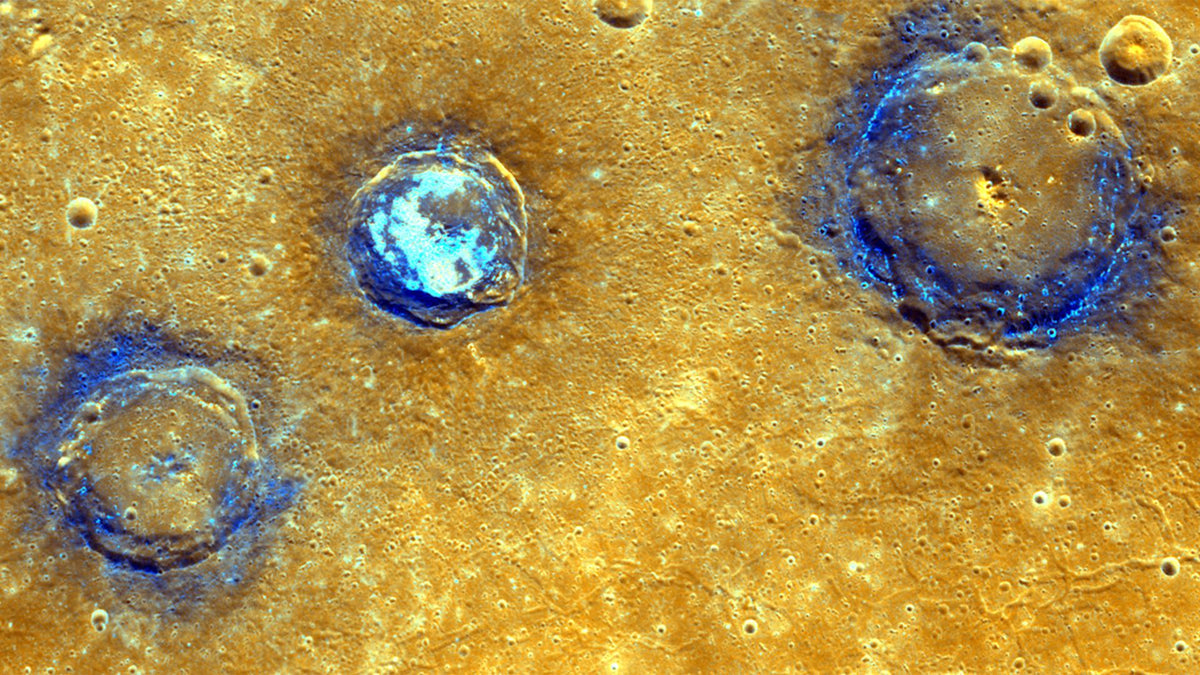
The archival MESSENGER image shows why orbiting Mercury is scientifically valuable. Its enhanced colours distinguish surface materials around craters in the Caloris basin; they are not the colours an astronaut would necessarily see. The observations date to July 2011. They do not show BepiColombo's arrival or a new result from this mission.
ESA's Mercury Planetary Orbiter instrument description sets out complementary investigations: a laser altimeter measures topography, thermal-infrared observations investigate surface properties, and radio science examines the gravity field and interior. A useful science campaign combines different measurements with known spacecraft positions. Completing orbital preparation is part of making those datasets interpretable.
The next milestones remain ahead
ESA still targets Mio's release on December 9 in Germany, December 10 in Japan. MPO is planned to reach its final orbit by March 2027, with science operations following in April. Capture establishes an important step; the later configuration and science programme remain prospective.
Join the conversation