
Ariane 6 deploys 36 Amazon Leo satellites after countdown delay
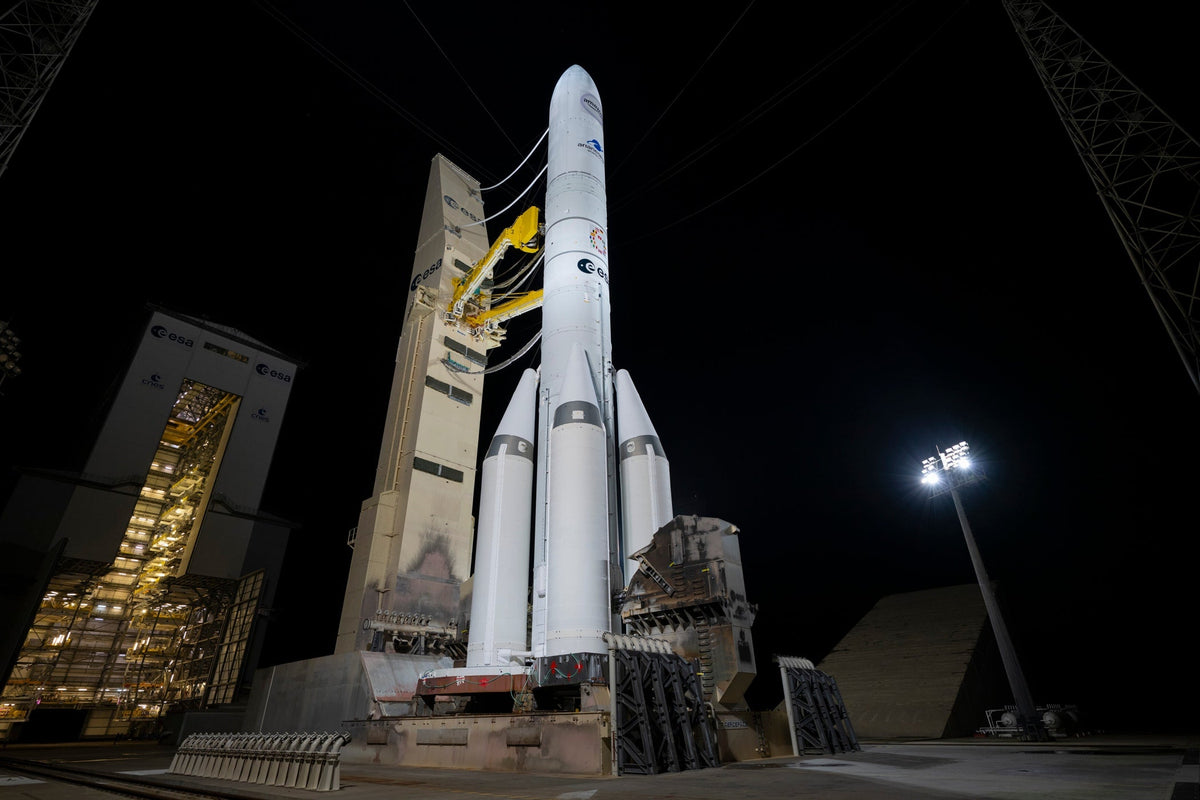
The new spacecraft have been released, but health checks, orbit raising and commissioning still separate launch delivery from service. Archival launcher imagery.
Ariane 6 delivered 36 Amazon Leo satellites into low Earth orbit on November 24, completing a mission that had been delayed by a ground-support problem the previous day. The four-booster rocket lifted off from Kourou, French Guiana, at 11:14 UTC, or 08:14 local time. Arianespace says the final satellite separated two hours and four minutes after liftoff.
Amazon has also confirmed the deployments and says its operations team has assumed control of the spacecraft. That is an important handover, but it is not the final step toward providing service: Amazon describes health checks, orbit raising and commissioning as the steps between release and service.
A completed flight after a ground delay

The flight was designated VA271 by Arianespace and LE-04 by Amazon. It was Ariane 6's tenth launch and its fourth mission for Amazon Leo. The operator's completion report brings Arianespace's total delivery for that constellation to 136 satellites.
The result is a new milestone beyond the November 23 countdown interruption. That earlier event occurred on the ground, before gantry withdrawal and launcher-system operations. The new reports establish successful launch and satellite release; they do not supply a detailed explanation of the component that caused the interruption.
The archival photograph shows the same four-booster, P160C-equipped Ariane 6 configuration on the earlier June 17 flight. It helps identify the launcher hardware, but it is not an image of November 24's launch.
Why the mission took more than two hours
Getting a payload above the atmosphere and giving it the right orbit are different tasks. Ariane 6's solid boosters and liquid-fuelled core provide the early push. The upper stage then uses its Vinci engine to shape the route on which the satellites will be released.
ESA's published flight sequence lists two Vinci burns separated by a coast, with deployment beginning about one hour and 39 minutes after liftoff. A coast is not a pause in motion. Once on an orbital trajectory, the stage continues around Earth without continuous engine thrust; another burn changes that trajectory.
ESA's engine description explains that Vinci can restart during a flight. An auxiliary propulsion unit supports the restart by managing conditions in the liquid-oxygen and liquid-hydrogen tanks. This gives the stage more flexibility than a single uninterrupted burn. The sequence is a published mission account, not an independently reconstructed telemetry record.
ESA also describes a final engine firing as a way to deorbit the spent upper stage and reduce debris. That is a launcher capability. The completion sources inspected for this article confirm satellite deployment but do not separately document the outcome of a disposal manoeuvre, so the two claims should be kept distinct.
Release altitude is not service altitude

Amazon reports that the satellites were deployed at approximately 465 kilometres above Earth. The launch operator gives the rounded figure of about 460 kilometres. Amazon's intended operational altitude for this batch is 630 kilometres.
Those heights describe different phases. First, the spacecraft separate from the launch system and the operator establishes contact and checks their health. Amazon then plans to raise them to their assigned operational orbits and commission them. A successful release therefore establishes delivery, while spacecraft readiness remains a subsequent process.
The illustration separates the reported release height from the planned operating height. Its arrow shows the progression between phases, not a measured trajectory, a time scale or a claim that every satellite has already reached the target.
More lift for a growing constellation
VA271 was the second Ariane 64 flight equipped with P160C-based boosters. Each motor holds 156 tonnes of solid propellant, 14 tonnes more than the earlier P120C. That additional propellant increases available launch performance; it does not mean every mission carries the launcher's maximum possible payload.
Amazon says the latest mission takes the wider Leo programme beyond 400 deployed satellites. Its customer-service ambitions extend beyond this one launch, and a deployed-satellite count should not be read as a count of spacecraft already commissioned or a guarantee of coverage in every location.
For this batch, the next evidence to watch is successful spacecraft checkout and progression toward the operating orbit. The confirmed achievement on November 24 is the delivery of 36 new satellites; building them into a working network continues after separation.
Join the conversation