
Progress 97 launches supplies toward the space station
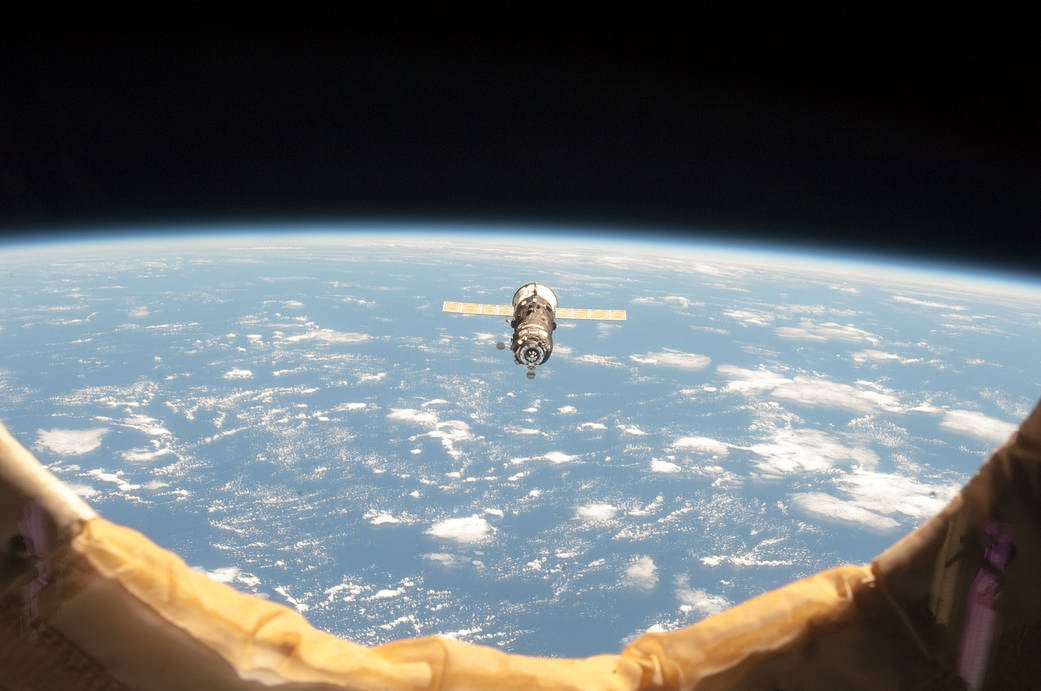
Archive photo: Progress 50, February 2013. Progress 97 is in orbit with about three tons of supplies; docking is scheduled for November 26.
Russia's uncrewed Progress 97 cargo spacecraft reached orbit on November 24 and began a two-day trip to the International Space Station. A Soyuz rocket lifted off from the Baikonur Cosmodrome in Kazakhstan at 10:17 UTC, or 5:17 a.m. EST, carrying about three tons of food, fuel and supplies for the Expedition 75 crew.
NASA's post-launch report confirms the departure. Arrival remains a separate milestone: autonomous docking at the Earth-facing port of the station's Rassvet module is scheduled for approximately 12:11 UTC, or 7:11 a.m. EST, on November 26.
In orbit, with the delivery still ahead
The distinction matters because launching the cargo and delivering it to the crew are different operations. Progress must complete its rendezvous, approach the assigned docking port and make a secure connection before its supplies can become available aboard the station. Being safely in orbit does not by itself establish that those later steps have succeeded.
The two-day interval is the announced profile for this mission. It should not be read as a fundamental limit on how quickly a Progress can reach a station. NASA's history of the vehicle family describes both the traditional two-day rendezvous and much shorter profiles used by modernized vehicles. Those alternatives provide context; they do not change the November 26 target announced for Progress 97.
The photograph is also deliberately historical. It shows Progress 50 approaching the station in February 2013, rather than today's spacecraft. Its value here is to show a real Progress on approach above Earth, without presenting an old docking image as evidence that the new cargo has arrived.
What a cargo ship carries besides boxes

Progress belongs to a vehicle family developed specifically to sustain space stations. Its job is broader than carrying parcels: the design combines an area for supplies with tanks and the systems needed to control the spacecraft in orbit.
NASA's general vehicle reference describes a pressurized cargo module, a refuelling module containing propellant and pressurized-gas tanks, and an instrumentation and propulsion module housing equipment and thrusters. That reference discusses earlier Progress variants, so it is useful for explaining the division of functions rather than treating it as a detailed drawing of Progress 97.
Keeping those functions separate helps explain the cargo announcement. Food and equipment occupy a different kind of storage space from fuel. Thrusters belong to the spacecraft's own operating systems. A headline cargo total does not describe the vehicle's full mass, and it does not tell readers how much of each commodity is aboard.
The current mission reports give about three tons as the combined load of food, fuel and supplies. They do not provide a complete item-by-item manifest. Assigning individual experiment names or precise fuel quantities to this delivery would therefore go beyond the evidence inspected for this article.
A long stay after a short flight
The mission preview says Progress 97 is expected to remain attached for about eight months. The orbital flight to the station is therefore only the beginning of its planned mission, rather than the whole useful life of the cargo ship.
Progress vehicles also provide a way to remove unwanted material. NASA's historical account describes crews filling emptied cargo space with trash before departure and destructive reentry. For Progress 97, NASA outlines a later departure and atmospheric reentry over the Pacific Ocean. Both remain future operations; the spacecraft has only just launched.
This is the logistical cycle behind sustained activity in orbit: deliver consumables and replacement equipment, keep the vehicle attached for its assigned stay, then manage its departure. The confirmed achievement on November 24 is a successful launch into orbit. The next decisive result will be a completed docking, followed by access to the cargo.
Join the conversation