
Hubble reveals a faint counterpart to Beta Pictoris’s “Cat’s Tail”
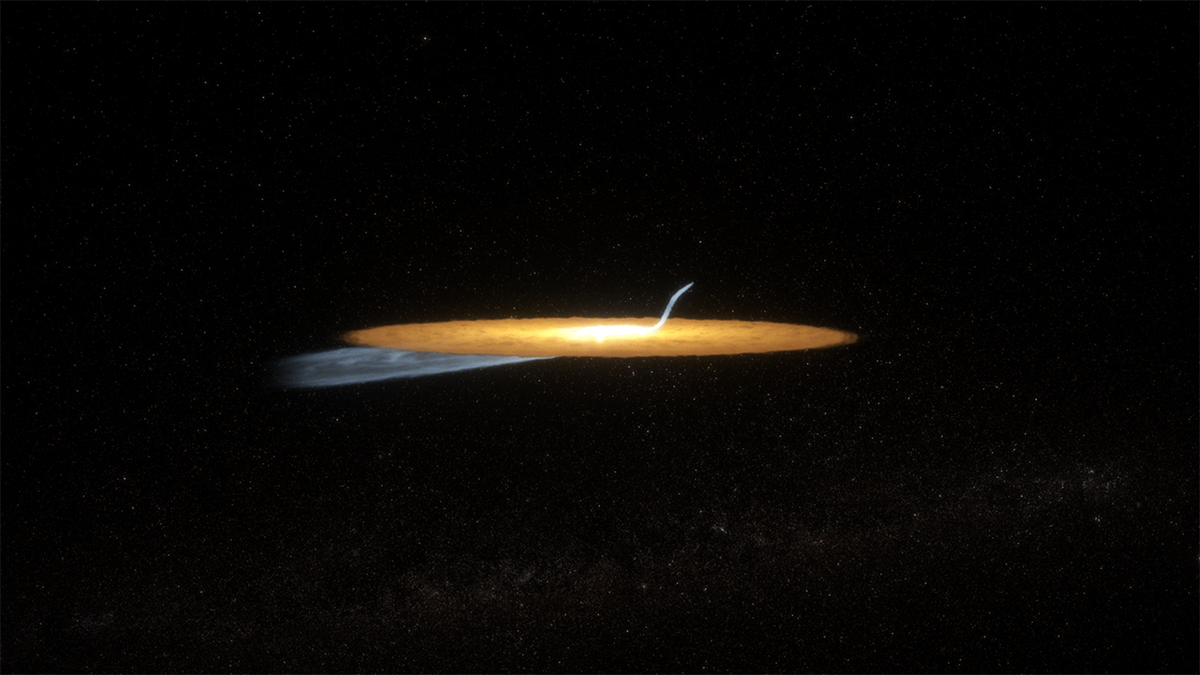
A recent analysis combines Hubble observations from 2012–2025 with Webb data to investigate a possible collision’s dusty aftermath. The grains’ composition and the collision itself remain interpretations of the evidence.
A recent Hubble analysis has recovered a faint, scattered-light counterpart to the “Cat’s Tail,” an unusual dust structure around the nearby star Beta Pictoris. The result gives astronomers another way to investigate debris that may have been produced in a collision between large icy bodies.

The University of Arizona described the work on October 28, 2026. Led by Arin Avsar, it combines six sets of Hubble observations from 2012–2025. The accepted research manuscript was posted in September; the tail’s original Webb discovery was announced in January 2024. This is a new analysis of an established feature, rather than a collision witnessed this week.
What Hubble adds to Webb’s view
Beta Pictoris is roughly 63 light-years away. Its surrounding debris disk contains material generated as smaller bodies collide. Webb’s Mid-Infrared Instrument revealed the curved tail through emission from warm dust.
Hubble’s Space Telescope Imaging Spectrograph instead records the much fainter starlight scattered by those grains. The team combined exposures, suppressed the bright star and subtracted much of the surrounding dust halo. The processed comparison below shows why this feature requires careful analysis rather than a glance at an ordinary photograph.

The Hubble feature resembles the Webb tail, but its outer end becomes too faint to follow. That difference need not mean the physical structure ends there: grains farther from the star receive less illuminating starlight.
Why dark dust can glow in infrared
A grain can absorb light, warm up and emit infrared radiation while scattering relatively little visible light towards a telescope. Comparing these two signals therefore helps constrain what the grains are like. Viewing angle also affects the scattered signal.

The researchers’ models favour very porous, carbon-rich grains. “Organic” in this context describes carbon-based material; it is not evidence of organisms. The material’s precise composition and the way such fluffy grains formed are still being investigated.
A collision hypothesis with remaining limits
Earlier Webb work proposed that a dust-producing event, possibly a collision, created the tail. In that picture, stellar radiation pushes the smallest, fluffiest grains outwards more efficiently than larger ones, helping stretch the debris into a tendril. It is a model for an aftermath, not a movie of the impact.
The new analysis strengthens constraints on the dust without uniquely fixing its geometry. Its detailed discussion allows the tail to lie behind the star or near the plane of the sky. Better modelling and additional wavelength measurements could distinguish these possibilities. A striking shape alone does not establish exactly which bodies collided or their sizes.
Join the conversation