
Swift re-enters Earth’s atmosphere, ending its time in orbit
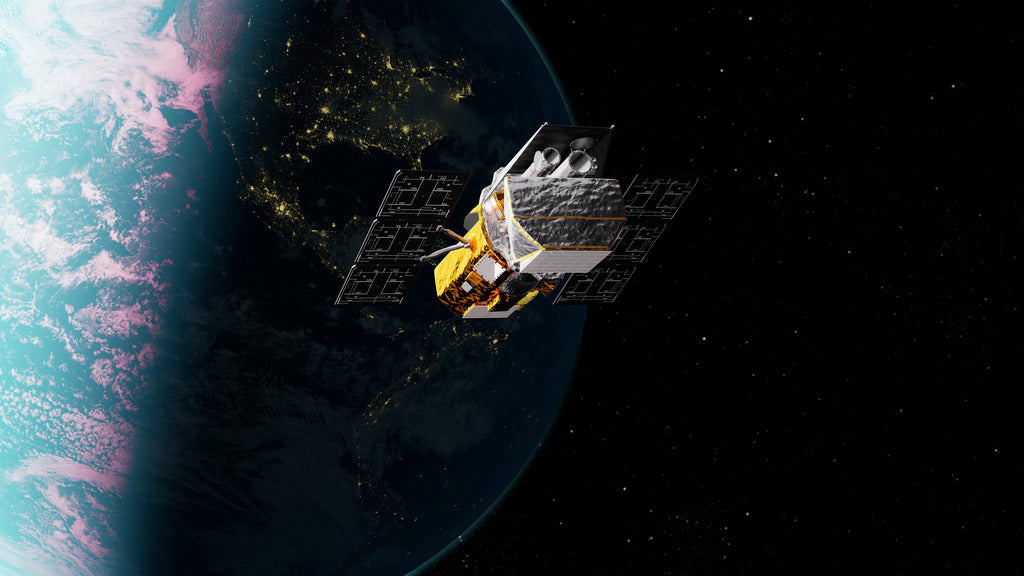
Tracking confirms a November 4 reentry over North Sumatra. The rapid-response observatory has stopped, but nearly 22 years of measurements remain available.
The Neil Gehrels Swift Observatory re-entered Earth’s atmosphere on November 4, ending the spacecraft’s almost 22 years in orbit. NASA’s updated mission notice reports that the U.S. Space Force confirmed reentry at 12:39 UTC—7:39 a.m. Eastern Standard Time—over the North Sumatra region of Indonesia.
What is confirmed, and what remains unknown?

The notice gives an approximate reentry position of 3.4 degrees north, 98.6 degrees east. That describes the reported atmospheric reentry location; it does not establish where any surviving pieces landed. NASA expected most of the observatory to burn up, while allowing that some components may have survived. The update does not provide a confirmed debris-recovery account.
This is a new milestone beyond the forecast we reported on November 2. A forecast window expresses uncertainty before the event. Today’s confirmation establishes that Swift has returned from orbit. Its science operations had already ended: the last observation was on October 20.
Why the orbit and the science mission ended at different times
Low Earth orbit still contains thin atmospheric gas. ESA’s explanation of orbital decay, written for the separate ERS-2 reentry in 2024, describes how denser air produces greater drag and faster decay. A satellite’s orientation also changes the surface area exposed to that gas. These are general physical effects, not an ESA measurement of Swift’s final path.
In its October 23 operational account, NASA reported that recent solar activity had increased drag on Swift. Observations were paused while the spacecraft was kept in a lower-drag orientation to support a proposed orbital boost. The servicing effort ended in August without a boost attempt, and Swift resumed observing.
Pointing at science targets increased drag again. By October 20, at about 275 kilometres altitude, Swift could no longer compensate for its effects and entered safe mode. The operations team then commanded the end of operations. A telescope can therefore stop producing usable observations before the spacecraft itself re-enters: it must hold its aim steadily enough to measure faint objects, not merely remain above Earth.
The rapid-response system astronomy has lost

Swift’s distinctive contribution was the connection between finding a short-lived event and examining it quickly. Its Burst Alert Telescope used a coded mask: a pattern of lead tiles cast a direction-dependent shadow onto detectors. Reconstructing that pattern gave a position for a gamma-ray burst, rather than just a signal that something had brightened.
That position supported two responses. Swift could turn autonomously so its narrower-field X-ray Telescope and Ultraviolet/Optical Telescope could observe the source, while the burst location was relayed to the ground for distribution to other astronomers. The diagram separates those branches; alerts did not have to wait for every follow-up image.
Speed mattered because a burst’s afterglow changes and fades. Observations in several kinds of light measured both its changing brightness and its spectrum—the distribution of light across energies or wavelengths. The mission archive description explains this combination of rapid alerts and multiwavelength follow-up.
See how the spacecraft changed its aim

The short NASA animation shows the spacecraft’s form and changes in pointing. Released in February 2025, it illustrates an observing capability; it is not footage of the November 4 reentry, a recording of one particular burst response, or a clocked demonstration of flight performance.
The spacecraft is gone; its measurements remain
Swift launched on November 20, 2004, for an initial two-year mission. In its mission-end assessment, NASA counted more than 2,000 observed gamma-ray bursts and about 7,000 scientific papers using Swift data. Those totals describe the accumulated mission, not observations made during reentry.
The public archive includes brightness measurements, spectra and more than 1.5 million ultraviolet/optical images. Reentry ends new measurements from Swift, but it does not erase data already delivered to Earth. Researchers can continue analysing that record. NASA says existing missions will help fill the rapid-response gap while it explores future options; that is a plan, not confirmation of a replacement with all of Swift’s capabilities.
Join the conversation