
Swift reentry forecast points to November 4, with hours of uncertainty
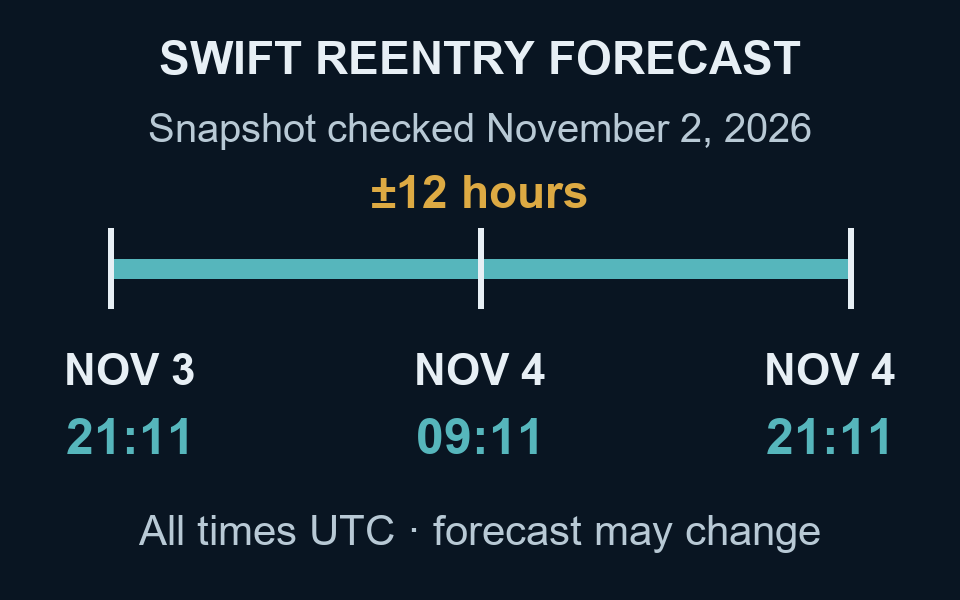
A November 2 check of The Aerospace Corporation’s forecast places Swift’s atmospheric reentry around November 4. The estimate carries a twelve-hour uncertainty on either side.
NASA’s retired Neil Gehrels Swift Observatory is nearing atmospheric reentry. A forecast from The Aerospace Corporation, checked on November 2, 2026, puts the central estimate at 09:11 UTC on November 4, with an uncertainty of ±12 hours. That is a prediction of reentry, not confirmation that the spacecraft has come down.
What the forecast window means
Adding and subtracting twelve hours gives a window from 21:11 UTC on November 3 to 21:11 UTC on November 4. The midpoint should not be read as a precise appointment with the atmosphere. The forecast’s listed orbit epoch is November 1 at 22:15:37.732 UTC: the time attached to the orbital information, rather than a stated publication time.

The Aerospace Corporation says possible reentry locations extend along the ground track within its uncertainty window. Its midpoint marker therefore does not identify a confirmed impact site. The timing can change as tracking improves; the live prediction page is the place to check after this dated report.
The science mission has already ended
Swift’s final observation was on October 20. In its October 23 mission-end announcement, NASA reported that the observatory had dropped below 275 kilometres in altitude and atmospheric drag was preventing steady pointing. That altitude describes NASA’s report at the time; it is not a new measurement for November 2.
Stopping observations and reentering the atmosphere are separate events. The first ended Swift’s ability to collect new science. The second marks the spacecraft’s physical return from orbit.
Why reentry is hard to time
Low orbit is not a perfect vacuum. Residual atmosphere produces drag, taking energy from a spacecraft’s orbit. As the orbit decays into denser air, drag increases. Forecasting the rate requires knowing how much atmosphere the spacecraft will encounter.

ESA’s explanation of natural reentries, published for the separate ERS-2 mission in 2024, describes two difficulties: atmospheric density depends partly on unpredictable solar activity, and the area exposed to the airflow depends on a satellite’s orientation. These are general physical limits on prediction, not an ESA forecast for Swift.
A fast response to a changing sky
Swift launched on November 20, 2004. Its three-instrument design linked a gamma-ray Burst Alert Telescope with X-ray and ultraviolet/optical telescopes. Detecting a burst could trigger an automatic turn, allowing the other instruments to study its fading afterglow while coordinates were relayed to the ground.

That rapid response made Swift valuable for studying transient events: phenomena whose brightness changes with time. Although the observatory has stopped collecting data, its archived observations remain a scientific resource. The immediate story is now its changing reentry forecast, with uncertainty that remains essential to understanding the date.
Reporting snapshot: November 2, 2026. The reentry estimate above is The Aerospace Corporation’s prediction, not a NASA-announced landing time.
Join the conversation