
Hubble study finds dwarf galaxies retain little of their oxygen
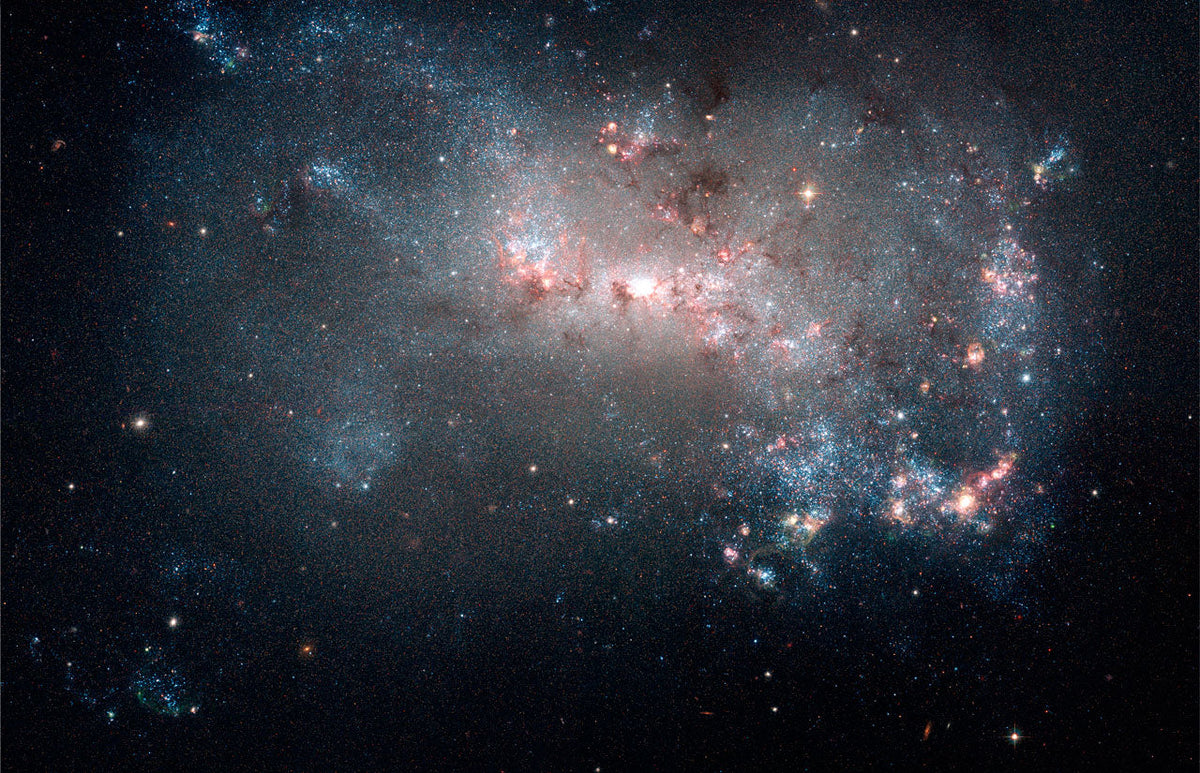
A census of 37 nearby dwarf galaxies finds that only about 11% of the oxygen their stars produced remains in their stars, gas and dust, on average. Where most of the rest went remains uncertain.
Astronomers have reconstructed the oxygen budgets of 37 nearby dwarf galaxies and found a substantial gap between what their stars should have made and what remains inside them. NASA highlighted the Hubble-based Galaxies Losing Oxygen via Winds study on November 2, 2026, alongside its reported publication in The Astrophysical Journal.

The research team's publicly available analysis reports retention fractions of roughly 4% to 25%, averaging about 11%. That is a fraction of the oxygen produced over the galaxies' stellar histories, rather than the percentage of all material in a galaxy that is oxygen.
What the oxygen budget measures
Stars manufacture oxygen and return chemically enriched material to their surroundings. Astronomers use it to follow how galaxies build up and redistribute elements heavier than hydrogen and helium. In this study, “missing” means absent from the inventory of stars, gas and dust within the galaxies. It does not mean oxygen atoms have vanished.

The team, led by Kristen B. W. McQuinn, studied gas-rich, low-mass galaxies within six megaparsecs of Earth. Most of the oxygen still counted in these systems is in their gas, with smaller contributions from stars and dust. The approximately 11% average describes this particular sample; it is not a universal retention rate for every dwarf galaxy.
How several telescopes build one census
Hubble can distinguish individual stars in these nearby galaxies. Their brightnesses and colours help researchers reconstruct stellar populations and star-formation histories. The companion GLOW I data atlas combines Hubble optical images with Spitzer infrared imaging, radio observations of atomic hydrogen and other ground-based measurements.
These measurements do different jobs. Stellar mass and an assumed oxygen yield estimate how much oxygen stars produced. Gas mass and oxygen abundance estimate the reservoir in the interstellar medium, the material between stars. The analysis also accounts for oxygen locked into stars, stellar remnants and dust before comparing the total retained with the estimated production.

This accounting depends on physical assumptions, including stellar yields, the conversion from infrared light to stellar mass, and whether measured gas abundances represent the wider galaxy. The paper discusses measurement and systematic uncertainties; the percentages are estimates, rather than a direct count of every oxygen atom.
Winds are implicated, but the destination is open
Massive stars and supernova explosions inject energy into gas and can drive enriched material outward. Small galaxies have shallower gravitational wells than massive ones, making this stellar feedback a plausible way to remove a large share of their oxygen. The GLOW comparison finds less retained oxygen than the hydrodynamical simulations examined by the authors predict.
That creates a useful test of galaxy models. Reproducing a galaxy's gas composition does not automatically mean a simulation has reproduced its whole history of element production and loss. The team also finds that a galaxy's environment can affect its oxygen retention, adding complexity beyond mass alone.
The unresolved question is how far the material travelled. Some ionized oxygen is known in the circumgalactic medium, the extended gas around galaxies. The researchers cannot yet say whether most of the shortfall is stored in those surrounding regions or has moved farther into intergalactic space.
New reporting, archival observations
The November 2 announcement is a journal-publication update: the GLOW II preprint was first posted August 7 and revised August 13, 2026. Its findings therefore were publicly available before this week's NASA release. The accompanying galaxy photograph is archival as well; neither the picture nor the announcement represents a newly observed cloud of escaping oxygen.
NASA says future work includes searching for still fainter galaxies with the Roman Space Telescope and studying stars in greater detail with Hubble and Webb. Those observations could extend the census and help explain the feedback behind it. Locating the bulk of the missing oxygen remains a separate scientific task.
Join the conversation