
Hubble’s new Messier 30 portrait revisits a cluster’s origins
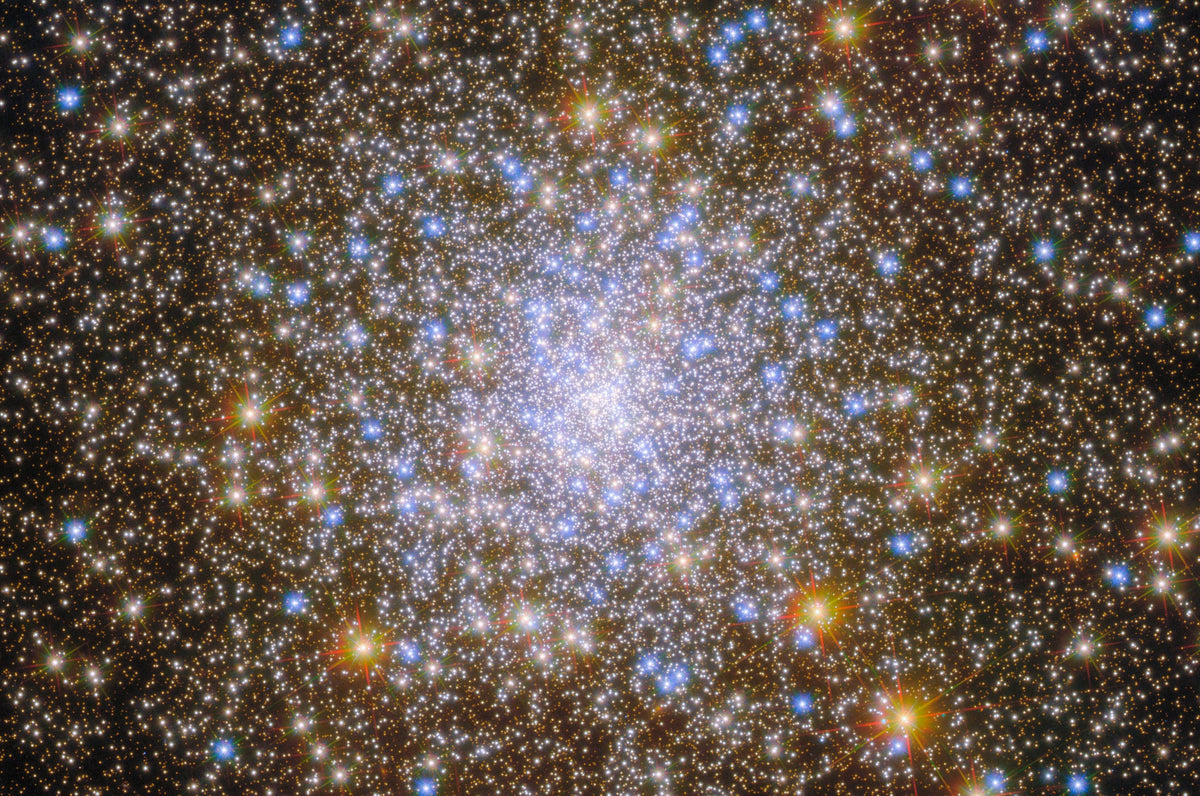
The portrait combines observations from three programs. The cluster’s backward orbit suggests the Milky Way acquired it from another galaxy, but its birthplace remains uncertain.
ESA and NASA released a new Hubble portrait of Messier 30 on November 5, combining observations that span roughly 15 years. The image brings a dense cluster of ancient stars into view. The measurements behind it also help explain why astronomers suspect this cluster was born outside the Milky Way.
Three observing programs, one star cluster

Messier 30, also cataloged as NGC 7099, is a globular cluster about 27,500 light-years away in Capricornus. Gravity binds the stars into a dense swarm. At its center, the light from many stars crowds together, making a telescope’s ability to separate nearby points of light especially valuable.
The Hubble release combines exposures with different jobs. An early survey used the Advanced Camera for Surveys to measure stars in red and near-infrared light. A later survey added three bluer filters from Wide Field Camera 3, including ultraviolet measurements. Comparing how brightly a star shines in different filters helps researchers distinguish groups of stars that can look similar in any one band.
How Hubble measures a star’s motion
A third program revisited clusters after years had passed. Researchers line up images on a common coordinate grid and measure how far each star has shifted across the sky. That change in position over time is called proper motion. The long interval makes tiny shifts easier to separate from measurement noise. Stars that move together can be separated from unrelated stars that happen to fall in the same view. Differences in the motions of cluster members also reveal how stars move within the cluster. Space Telescope Science Institute proper-motion catalogs.
There are two scales of motion in this story. The small shifts between stars tell astronomers about the cluster’s internal dynamics. To reconstruct the cluster’s orbit around the Milky Way, researchers need its overall motion, its distance and its speed toward or away from us. An orbit also depends on the model of the galaxy’s gravity used to calculate it.
Why the backward orbit is one clue

Messier 30 circles the galaxy in the opposite direction to the Milky Way disk’s rotation. That kind of orbit can be a clue that a cluster came in with a smaller galaxy. Researchers also compare ages and chemistry. Groups of clusters born in the same galaxy can follow a pattern in age and metallicity, the abundance of elements heavier than helium.
A 2025 study of clusters linked to Gaia–Sausage–Enceladus, an ancient merger, found Messier 30 somewhat younger than the group’s trend at its measured metallicity. The authors considered another parent galaxy possible. An August 2026 analysis that combined ages, metallicities and orbital properties still grouped it with Gaia–Sausage–Enceladus. The two results show how the answer depends on the clues researchers weigh together. The new Hubble portrait brings those observations into one view while the cluster’s exact birthplace remains an open question.
Join the conversation