
Localized gas near Alba Mons hints at activity inside Mars
A new study connects rare hydrogen chloride detections with fractured terrain near Alba Mons. The seasonal pattern may point to an underground igneous source, but no eruption or exact gas vent has been observed.
A trace gas appearing in an unexpected place and season has given scientists a new reason to investigate whether Mars still has active igneous processes underground. A study published on November 4 in Science Advances links localized hydrogen chloride detections near Alba Mons with fractured terrain that could provide routes from the subsurface to the atmosphere. It offers an explanation to test, rather than a confirmed sighting of an eruption.
The clue is where and when the gas appears
Hydrogen chloride, or HCl, contains hydrogen and chlorine. The Atmospheric Chemistry Suite aboard the joint ESA–Roscosmos ExoMars Trace Gas Orbiter has previously detected it across broad areas of Mars during the warmer, dustier southern spring and summer. Reactions involving dust, water and ice can explain much of that seasonal pattern. Detecting HCl alone therefore does not identify a volcanic source.
The new paper by Alexander Trokhimovskiy, Daniel Mège and colleagues examines a different pattern: rare detections during the cooler part of Mars’s orbit around aphelion, its greatest distance from the Sun. Eight confident detections from two Martian years clustered near Alba Mons, rather than spreading around the planet. They were among 78 northern-hemisphere observations made in the seasonal interval studied.
The gas was concentrated near the surface, with a steep decrease through the first 10 kilometres of atmosphere and peak abundances reaching 1.5 parts per billion by volume. That means roughly 1.5 HCl molecules for every billion molecules of air. Most other observations in that search, including some in the same region, gave upper limits of 0.2 parts per billion or less. The contrast in location, season and height is the central evidence, not simply the presence of chlorine on Mars.
Reading sunlight through the edge of the atmosphere

The instrument identifies gases by their infrared absorption lines. During a solar occultation, it looks toward the Sun through the edge of the Martian atmosphere. Different molecules remove particular wavelengths from the light. As the line of sight crosses different heights, the team retrieves a vertical profile of HCl abundance.
This is remote atmospheric sampling, not a camera watching gas escape from a particular crack. Dust and ice can obstruct the lowest layers; clearer conditions improve access to the air near the ground. The authors also report localized detections in Earth’s summer of 2025, but reserve their detailed analysis for another study. Today’s development is publication of the interpretation, not an eruption observed on November 4.
Why the researchers looked at fractures

Alba Mons lies in the volcanic Tharsis region. To connect the atmospheric signal with the ground, the researchers examined high-resolution images from TGO’s CaSSIS camera and NASA’s Mars Reconnaissance Orbiter, alongside topographic information. They looked for geological structures that could plausibly carry gas upward.

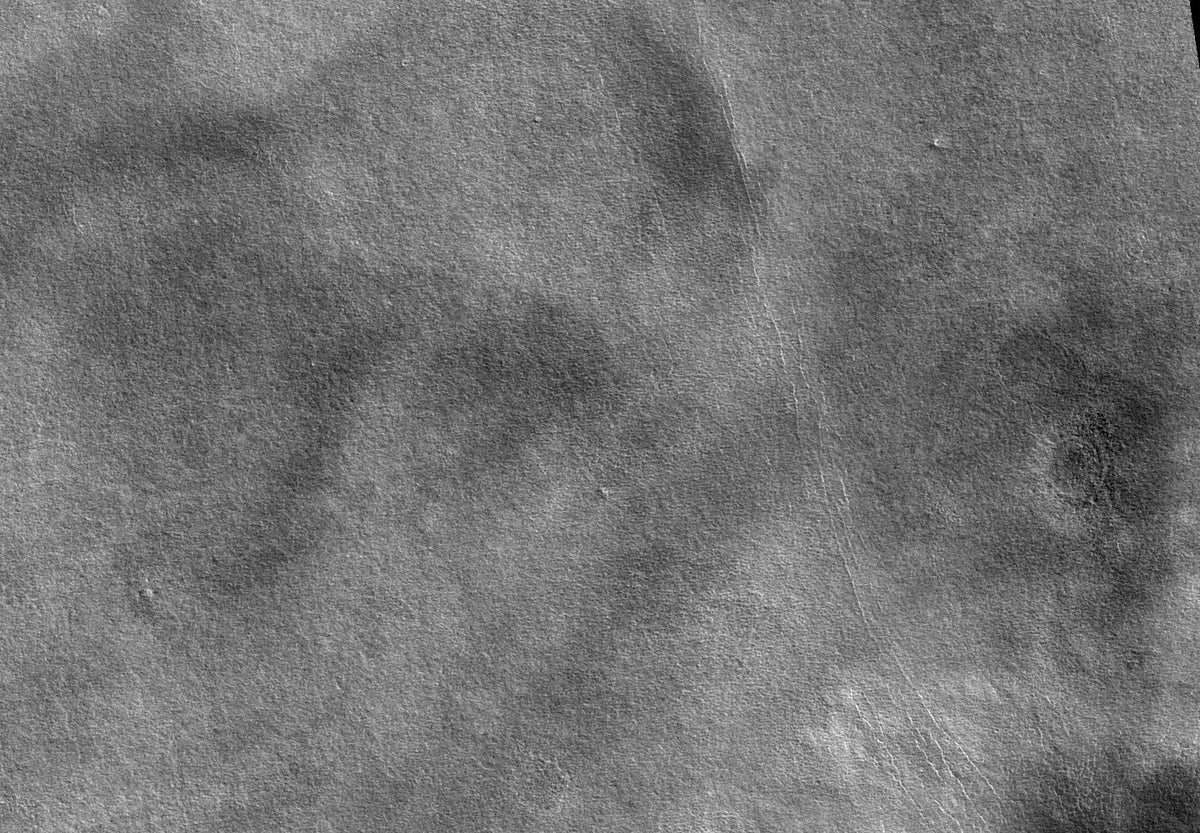
Some ridges and troughs contain exceptionally narrow fissures cutting an ice-rich surface mantle. The team interprets their geometry, geological setting and apparently fresh appearance as possible evidence of pathways linked to igneous processes below. The detailed HiRISE image shows an example of the terrain they investigated; the wider archival view provides its regional context.
There are important limits. The search identified landforms consistent with possible seepage, not the exact vents supplying the measured gas. Comparisons of older and newer images found no identifiable change, and the study found no notable local warming. “Fresh” describes a geological interpretation of the structures; it does not mean a fissure was filmed opening during these observations.
How gas could reach the air without a lava flow
In the authors’ preferred explanation, igneous activity at depth supplies gas to a fracture network. The gas could rise directly or interact with the ice-rich shallow subsurface before release. Frozen ground and chlorine-bearing materials could temporarily retain or transform it, so the gas measured overhead need not have travelled straight from magma to the instrument.
Seasonal warming and sublimation—the change from ice to vapour—could help release stored gas. Once airborne, HCl can be removed rapidly by ice particles. A short atmospheric lifetime would help keep a weak source localized instead of allowing its gas to spread widely. These steps describe a proposed mechanism; the study has not directly imaged the underground plumbing.
A promising explanation with alternatives to test
The authors find that current atmospheric-chemistry models do not reproduce this particular localized, cool-season pattern. They also consider mud volcanism and the breakdown of chlorine-bearing salts. Because the relevant materials and terrains occur more widely across the northern lowlands, their presence alone does not explain why the detections cluster here.
That makes a local igneous source their preferred interpretation, while leaving the physical source and release process unresolved. Further observations can test whether the same places repeatedly produce HCl at the predicted seasons and whether other evidence supports a subsurface source. The result strengthens a specific case for investigating present-day activity inside Mars; it does not establish an imminent eruption or confirm liquid water or life.
Join the conversation