
New Hubble and Webb images reveal the Cat’s Head Nebula
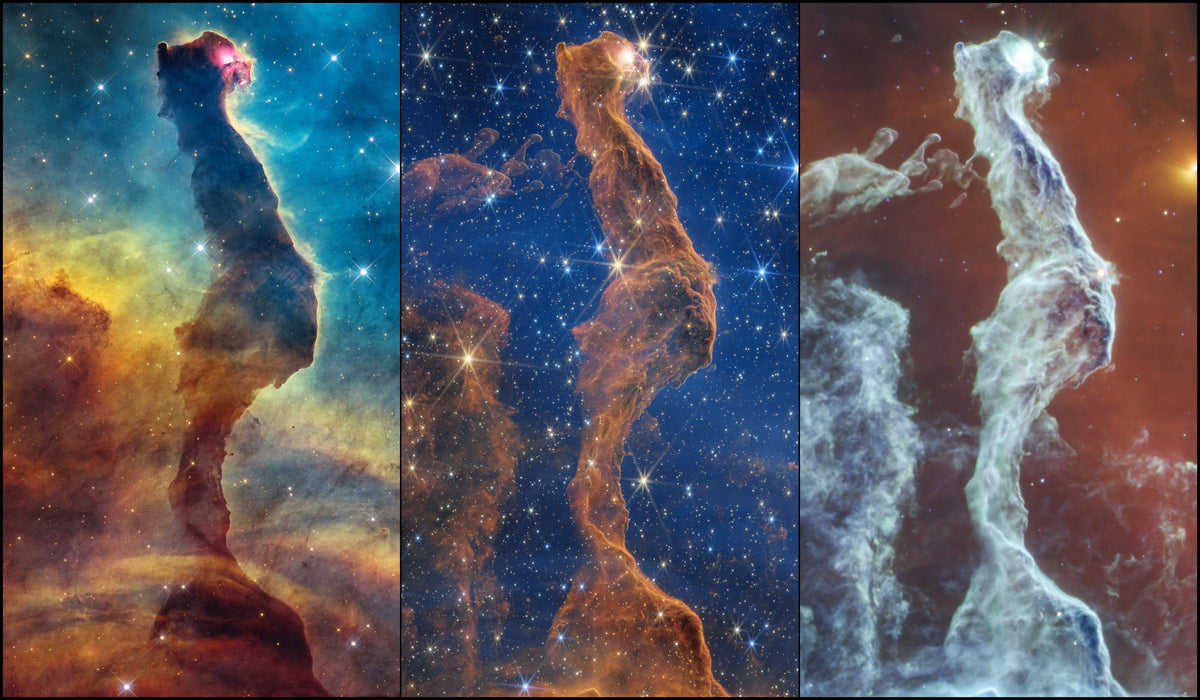
Visible and infrared observations show a dusty stellar nursery in three different ways, revealing how stars and radiation shape the Cat’s Head Nebula.
New images released on October 29 show how differently the same stellar nursery can appear through Hubble and the James Webb Space Telescope. Their subject is a dusty pillar nicknamed the Cat’s Head Nebula, a small part of the Carina Nebula about 7,500 light-years from Earth.
The comparison brings together visible, near-infrared and mid-infrared observations. It is a new public image release, rather than a report that the nebula has just been discovered.
A dark silhouette in visible light
Hubble shows a dark pillar against bright surrounding gas. A pink-red patch near its upper right edge creates the impression of a cat’s eye. According to the mission teams, that feature may mark a young star still embedded in dust.
The bright rim along the pillar is consistent with gas exposed to ultraviolet radiation from nearby massive stars. That radiation can heat the gas and help erode the cloud, a process called photoevaporation. The denser pillar has resisted that erosion longer than some of the material around it.

Webb reveals a different view
In the middle panel of the header image, Webb’s Near-Infrared Camera reveals many more stars and finer structure within the dusty pillar. Some material becomes easier to see through at these infrared wavelengths, although infrared light does not make every dust-obscured star visible.
The right-hand panel comes from Webb’s Mid-Infrared Instrument. Here, emission from warm dust and carbon-based molecules highlights filaments and smaller structures around the pillar. The changing appearance reflects the different light each instrument records.
Three views rather than a time sequence
The colors are assigned to measurements through different telescope filters. They help distinguish structures and emission; the comparison is not a set of ordinary camera photographs showing how the nebula would look to human eyes.
The observations also predate the release. NASA’s image records list January 15, 2026 for Hubble and May 27, 2026 for Webb’s two instruments. The panels should therefore be read as complementary wavelength views, not as a sequence showing the pillar changing shape between photographs.
Together, they expose both sides of the scene: dense material that conceals parts of a stellar nursery, and radiation from massive stars reshaping its surroundings.
Sources
- NASA mission-team release, October 29, 2026
- ESA/Webb image release and three-view comparison
- Observation and color-processing records: Hubble, Webb NIRCam and Webb MIRI
Join the conversation