
How a star’s tiny apparent shift reveals its distance
Earth’s orbit gives astronomers changing viewpoints on the stars. Measuring the resulting apparent shift turns a small angle into a distance, provided the uncertainties are handled carefully.
A star can appear to change position even when the change comes from us. As Earth travels around the Sun, a nearby star shifts slightly against the more distant background. Measuring that effect, called stellar parallax, gives astronomers a way to determine distance through geometry.
Earth supplies the changing viewpoint
Hold a finger still and look at it with one eye, then the other. It seems to jump relative to the room behind it because your eyes occupy different positions. Moving the finger farther away makes that apparent jump smaller.
For stars, Earth’s orbit provides the separation. Observations six months apart can use opposite sides of the orbit, roughly twice the average Earth–Sun distance apart. Astronomers compare the target’s direction against more distant reference objects, rather than reading its distance from how large its image looks.

Turning an angle into parsecs
The conventional parallax angle, p, is tied to a baseline of one astronomical unit: the average Earth–Sun distance. In the idealized diagram above, it is half the full change between the two viewpoints. Confusing that angle with the full displacement would give the wrong distance.
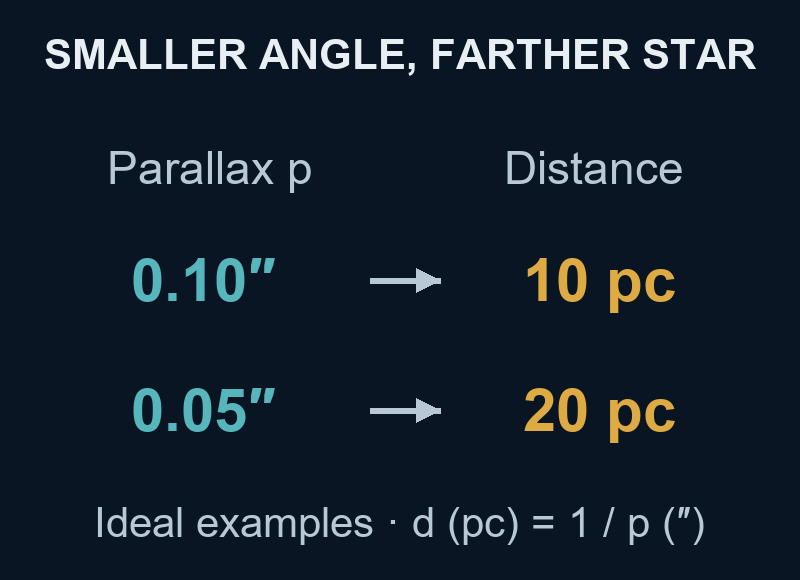
With p expressed in arcseconds, the ideal relation is distance in parsecs = 1 ÷ p. An arcsecond is 1/3,600 of a degree. A parsec is about 3.26 light-years; it measures distance.

For example, 0.10 arcseconds corresponds to 10 parsecs, or about 32.6 light-years. Halving the angle to 0.05 arcseconds gives 20 parsecs. These are clean arithmetic examples, rather than results for particular stars.
A larger baseline can reveal the shift
A New Horizons demonstration in April 2020 compared views of Proxima Centauri and Wolf 359 from Earth and the distant spacecraft. That much larger separation made the apparent differences easy to see in paired images. The observations were reported in June 2020; they are an archival example of the method, not a new result.

The annotated field above identifies one of those targets. A single view tells us where Proxima appears on the sky. Establishing its parallax requires comparing its position from different viewpoints.
Real stars require more than two snapshots
Stars also move through space. Their resulting drift across the sky is called proper motion. Repeated observations let astronomers separate this longer-term drift from the parallax pattern that repeats with the observer’s yearly orbit. Instrumental measurement errors must also be considered.
The reciprocal formula is most useful when the parallax is well measured. A 2021 study of Gaia distances explains why large relative uncertainties prevent simply inverting many measured parallaxes. Statistical estimates can combine the measurement with additional information, and should retain a range of plausible distances.
The geometric idea is simple; the precision work lies in extracting a tiny repeating signal without mistaking motion or noise for distance.
Join the conversation