
Why Jupiter bulges at its equator
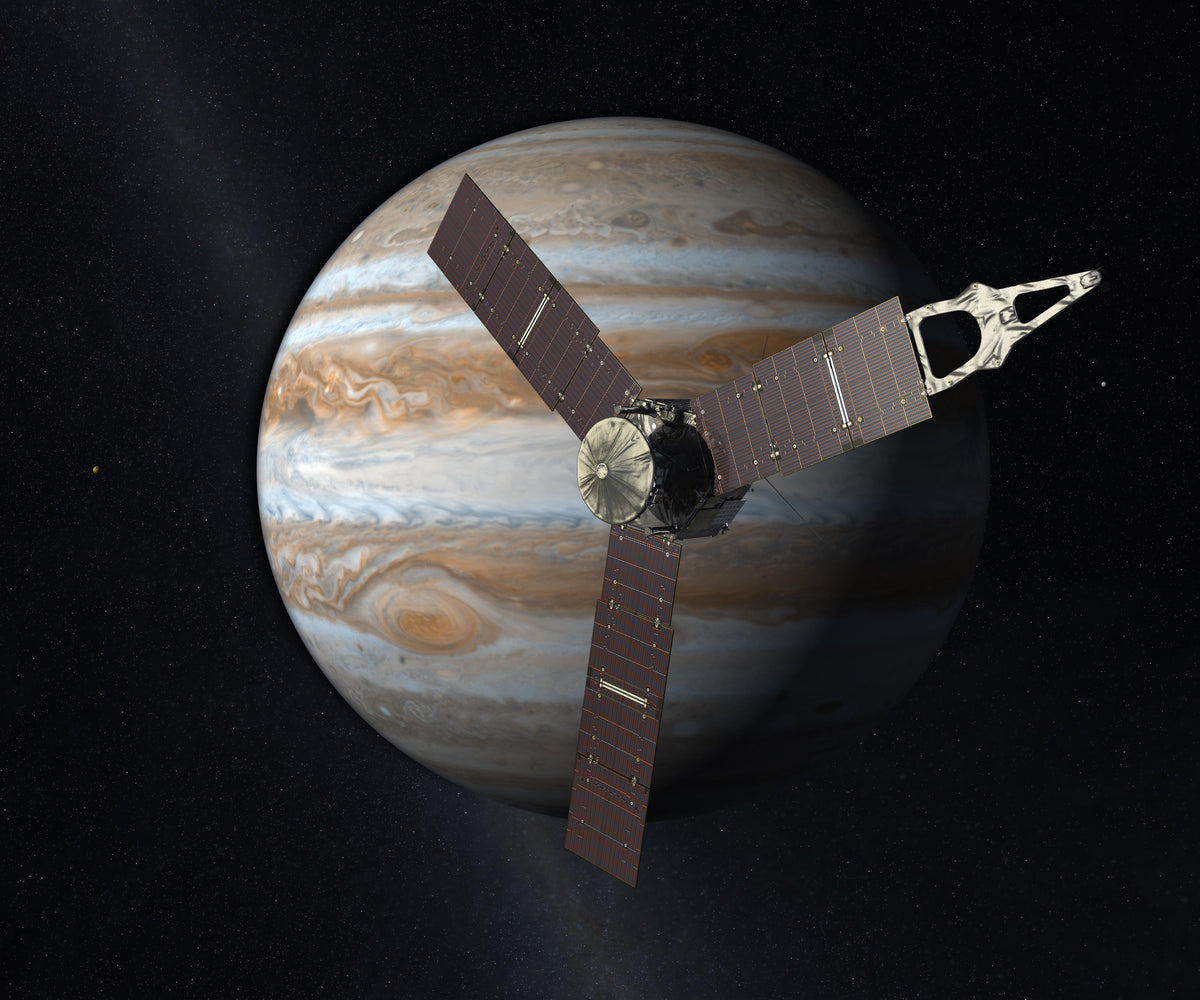
Jupiter’s rapid rotation helps make it about 7% wider across the equator than from pole to pole. Radio measurements reveal how its fluid interior and atmospheric winds refine that shape.
Jupiter is round, but it is not a perfect ball. Its diameter across the equator is about 7% greater than its diameter from pole to pole. Its rapid spin helps produce that extra width, while the distribution of material inside the planet and powerful atmospheric winds refine its shape.
Gravity gathers the planet; rotation changes its outline
Gravity pulls a large planet’s material inward. If a fluid planet were not rotating, a sphere would be a natural starting point for describing its shape. Rotation introduces another requirement: material away from the spin axis must keep moving around that axis.
In a frame that turns with the planet, this is described by an outward centrifugal effect. It grows with distance from the rotation axis, so it is strongest at the equator and vanishes on the axis itself. The planet’s material settles into a wider equatorial shape as pressure, gravity and rotation balance. Gravity continues to hold Jupiter together.

This flattened, nearly spherical form is called an oblate spheroid. The same basic process affects other rotating planets, including Earth. Jupiter’s distortion is much easier to notice; it is still a globe, rather than a disk.
A fast day on a fluid world
Jupiter turns in about 9.9 hours, giving it the shortest rotation period among the solar system’s eight planets. Its visible stripes are clouds above a world made mostly of hydrogen and helium. At greater depths, rising pressure turns hydrogen into liquid; there is no solid surface on which a visitor could land.
Those properties matter when describing its outline. A fluid planet can redistribute material, and the way density changes with depth affects its equilibrium shape. East–west winds add smaller departures from the simplest rotating model. Knowing the rotation period alone does not specify every detail of the planet’s boundary. NASA’s Jupiter overview explains the distinction between its atmosphere and interior.

Where does a planet without a surface end?
For a precise size, scientists must choose a reference level in the atmosphere. A common choice for Jupiter is where pressure reaches one bar, approximately the atmospheric pressure at sea level on Earth. That is a defined layer, rather than a rocky ground or a sharply defined edge of the gas.
A 2026 study by Eli Galanti and colleagues estimated Jupiter’s radius at that level as 71,488 kilometres at the equator and 66,842 kilometres at the poles, with reported uncertainties of 0.4 kilometres for each. Doubling those radii gives diameters of roughly 143,000 and 134,000 kilometres. The diagram above rounds these values and approximates the outline as an ellipse; the real planet has smaller departures from that simple form.
Radio signals supply a different kind of ruler
During a radio occultation, a spacecraft’s signal passes through the atmosphere near a planet’s apparent edge on its way to Earth. Changes in the signal reveal how the intervening atmosphere bends the radio waves. Researchers use this information to recover atmospheric profiles and constrain the planet’s shape.

The study combined Juno radio measurements with information about winds and gravity. Its Juno measurements sampled higher atmospheric layers; the one-bar result also used a deeper Voyager measurement and assumptions about the winds. This was a model informed by multiple measurements, rather than a photograph of a solid surface.
The paper was published in February 2026, and NASA described it on February 4. It refined an existing measurement: Jupiter had not suddenly shrunk. A better boundary helps researchers test models of how material is arranged inside the giant planet, and improves a reference used when studying giant planets around other stars.
Join the conversation