
Why sunsets on Mars can look blue
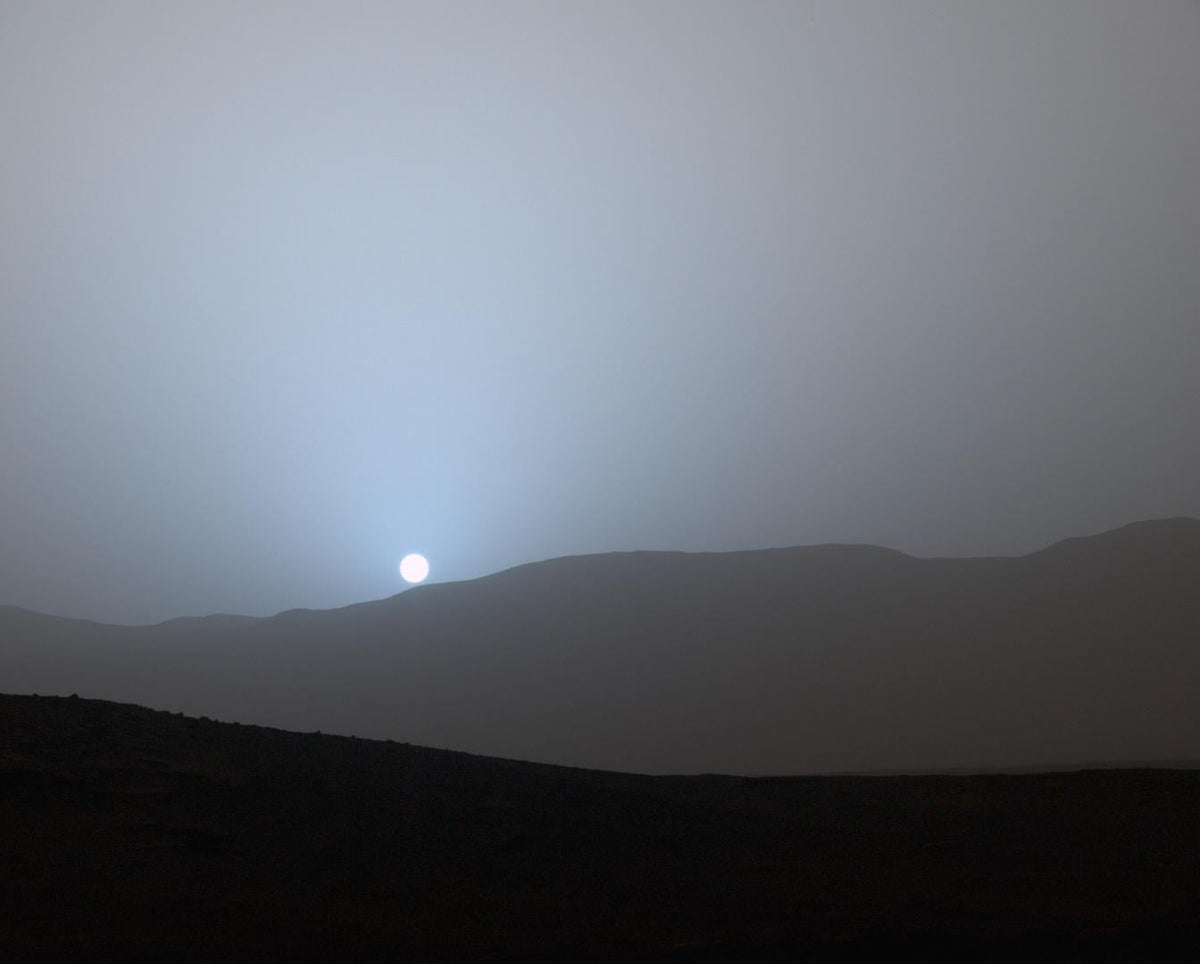
Fine dust changes how sunlight spreads through Mars’ atmosphere, concentrating a blue glow near the setting Sun.
Mars can have a blue glow around the setting Sun even though its daytime sky often looks orange or reddish. Fine dust suspended in the atmosphere changes how different colors of sunlight reach an observer.
How dust redirects sunlight
Sunlight contains a mixture of visible wavelengths. Blue light has a shorter wavelength than red light. When light encounters material in an atmosphere, some of it changes direction: a process called scattering.
Martian dust produces a distinctive pattern. Blue light is concentrated into a narrower region near the Sun’s direction, while yellow and red light spread more widely across the sky. The result can be a blue or blue-gray halo around the Sun, with warmer colors elsewhere.
Why sunset strengthens the effect
When the Sun is low, its light follows a longer path through the atmosphere than it does around midday. That makes the dust’s influence on the colors near the Sun more noticeable.
Earth’s familiar red and orange sunsets arise under different scattering conditions. Air molecules redirect much of the shorter-wavelength blue light away from the direct path to an observer. With the Sun near the horizon, more of the reds and yellows remain in the light arriving directly from it.
Reading Curiosity’s photograph
The image above is an archival Curiosity view from Gale Crater, taken on April 15, 2015, with the rover’s left Mastcam camera. NASA calibrated and white-balanced the published color image to remove camera artifacts.
The observations were made between dust storms, with some dust still suspended in the air. NASA’s mission account explains that watching the sunset helps researchers assess how dust is distributed vertically in the atmosphere. The blue glow is both a striking view and a clue to the air above the landscape.
Join the conversation