
Why Webb must stay cold to see infrared light

Warm telescope hardware emits infrared light of its own. Webb’s layered sunshield limits that background, while MIRI needs additional refrigeration to observe longer wavelengths.
The James Webb Space Telescope needs more than darkness to detect faint infrared light. It must also keep its own hardware cold, because warm mirrors and instruments emit infrared radiation that can interfere with the signals astronomers want to measure.
The telescope can add its own glow
Infrared is light beyond the red end of human vision. Cosmic objects emit it, but so does warm telescope hardware. An instrument looking for a weak astronomical signal must distinguish that signal from this unwanted background. Cooling the observatory reduces its own infrared emission; it does not make the target brighter. Webb’s thermal-design explainer describes how that requirement shaped the entire telescope.

There is also an electrical problem inside a detector. It can produce a signal even without incoming light, known as dark current. Lower temperatures suppress this source of interference too. It is distinct from stray infrared photons arriving from warm equipment. The mission team explains both effects here.
Five separated layers protect the cold side
Webb’s sunshield is roughly the size of a tennis court. Its five thin, coated plastic membranes separate the warm spacecraft side from the mirrors and science instruments. The sheets reflect radiation, while their spacing and shape let heat radiate out around the edges. Each successive layer toward the telescope is cooler.

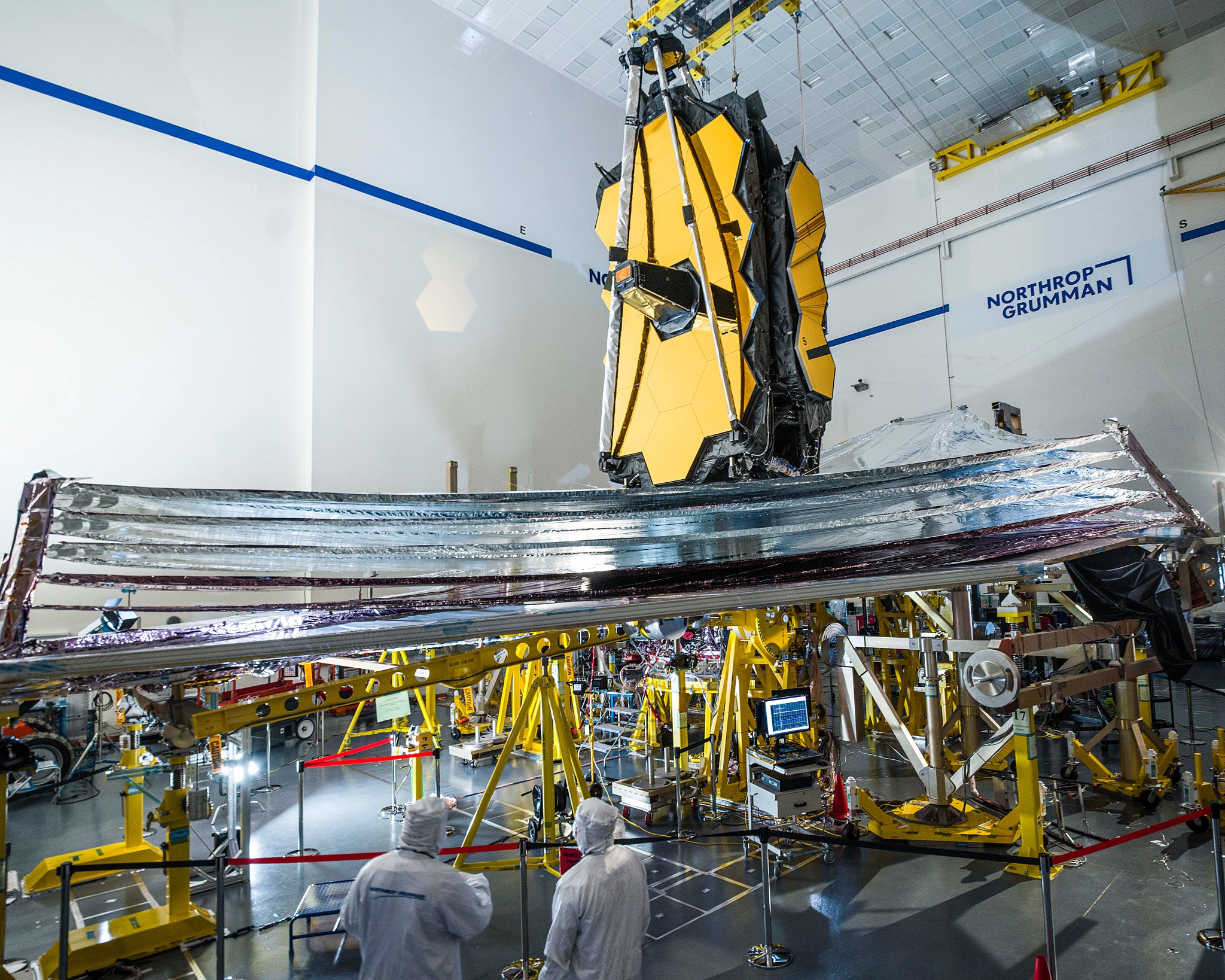
The gaps matter. Keeping the membranes apart reduces direct heat conduction between them. A single thick sheet would pass more heat from its warm side to its cold side than the layered design. The shield also helps keep temperatures stable as Webb points within its allowed observing range. NASA’s sunshield overview explains why the team chose five layers.

Why one instrument needs a refrigerator
Most of Webb’s observing hardware can cool by radiating energy into space from the protected side. The Mid-Infrared Instrument, or MIRI, needs an extra step: an electrically powered cryocooler. Its detectors observe longer infrared wavelengths than Webb’s other instruments and operate below 7 kelvins, about −266°C. That is an instrument requirement, not the temperature of the whole spacecraft.
The mission’s April 2022 cooldown report records reaching that threshold. ESA’s MIRI guide describes the additional cooling and the instrument’s role. These are established engineering facts, rather than a new cooldown announcement.
Location helps the shield do its job
Webb operates around the Sun–Earth L2 region, roughly 1.5 million kilometres beyond Earth. This location lets the observatory keep the Sun, Earth and Moon on the shielded side. Its open telescope design also lets unwanted heat escape into space. Distance alone is not the cooling system: the geometry, reflective layers and, for MIRI, active refrigeration work together to preserve faint infrared signals.
Join the conversation