
A Sneak Peek into 2024's Most Exciting Space Missions
Introduction
The year 2024 promises to be a thrilling time for space exploration, with several groundbreaking missions scheduled to take us beyond our planetary boundaries.
From unraveling the mysteries of Jupiter's moon Europa to venturing back to the moon and even setting sights on Mars' enigmatic moons, these missions are set to reshape our understanding of the cosmos. Let's take a closer look at some of the most anticipated space adventures that will captivate the world's attention in the coming year.
1.Europa Clipper
Unraveling the Secrets of an Icy Moon NASA's Europa Clipper is gearing up for an extraordinary mission to explore Europa, one of Jupiter's largest moons. With its icy surface and a suspected subsurface ocean containing more water than all of Earth's oceans combined, Europa is a prime candidate in the search for extraterrestrial life.
The spacecraft, set to launch on a SpaceX Falcon Heavy rocket, will conduct nearly 50 flybys to study the moon's icy shell, geology, and subsurface ocean. This mission promises to revolutionize our understanding of ocean worlds, with a launch window opening on October 10, 2024.

The main body of the Europa Clipper spacecraft arrived at the clean room of JPL in early June 2022. (Image credit: NASA/JPL-Caltech/Johns Hopkins APL/Ed Whitman)
2.Artemis II Launch
Humanity's Return to the Moon NASA's Artemis program, named after the twin sister of Apollo in Greek mythology, is poised to send humans back to the moon for the first time since 1972. Artemis II, the first crewed mission in this ambitious program, aims to put four astronauts into orbit around the moon for a 10-day mission.
Building upon the success of Artemis I, which sent an uncrewed capsule into lunar orbit in late 2022, this mission is scheduled for launch in November 2024, marking a significant step toward a sustained human presence on the moon and paving the way for future missions to Mars.
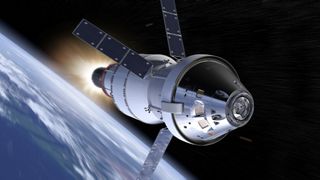
The Orion spacecraft during trans-lunar injection, to bring an Artemis mission to the moon. (Image credit: NASA)
3.VIPER
Seeking Water on the Lunar South Pole Scheduled for a November 2024 launch, the Volatiles Investigating Polar Exploration Rover (VIPER) is a robotic mission designed to explore the moon's south pole. About the size of a golf cart, VIPER will search for volatiles, including water and carbon dioxide, which could serve as valuable resources for future lunar exploration.
Navigating extreme temperature variations, VIPER's 100-day mission will contribute crucial data for advancing our understanding of the moon's composition and potential as a stepping stone for human exploration.
NASA’s VIPER rover will help pave the way for future Artemis crewed landings by scouting the lunar south polar region. (Image credit: NASA)

4.Lunar Trailblazer and PRIME-1
Small Missions, Big Discoveries As part of NASA's Small, Innovative Missions for Planetary Exploration (SIMPLEx) initiative, Lunar Trailblazer is set to orbit the moon, mapping water molecules across its surface.
A secondary payload on the PRIME-1 mission, scheduled for a mid-2024 launch, Lunar Trailblazer's findings will complement the data collected by other lunar missions, providing a comprehensive understanding of lunar water distribution.

A rendering of Lunar Trailblazer in orbit above the moon. (Image credit: Lockheed Martin)
5.JAXA's MMX Mission
Probing Mars' Mysterious Moons Japan Aerospace Exploration Agency's (JAXA) Martian Moon eXploration (MMX) mission is gearing up to launch around September 2024.
Focused on Phobos and Deimos, Mars' moons, MMX aims to determine their origin—whether they are captured asteroids or formed from Mars' orbital debris. With a planned three-year mission around Mars, including a sample collection from Phobos' surface, MMX holds the key to unraveling the mysteries of these enigmatic moons.
(image credit: JAXA)

6.ESA's Hera Mission
Deflecting Asteroids for Planetary Defense Hera, a mission by the European Space Agency (ESA), follows in the footsteps of NASA's DART mission to the Didymos-Dimorphos asteroid system. DART demonstrated the kinetic impact technique, altering an asteroid's orbit for potential planetary defense.
Scheduled for an October 2024 launch, Hera will study the physical properties of these asteroids, providing essential insights into our ability to deflect hazardous objects on a collision course with Earth.
An artist's depiction of the Hera mission at the binary asteroid Didymos. (Image credit: ESA–ScienceOffice.org)

Conclusion
As we stand on the brink of 2024, these space missions promise to redefine our understanding of the cosmos and pave the way for future explorations. From unraveling the mysteries of distant moons to preparing for human missions to the moon and Mars, the coming year is poised to be a thrilling chapter in the ongoing saga of space exploration. Get ready to witness history unfold as we venture into the extraterrestrial frontier.
Join one million Future fans by liking us on Facebook, or follow us on Twitter or Instagram.
Join the conversation
I find it truly amazing where we’d come. I think that the next decade belongs to space exploration if we gonna leave all this insignificant political things behind…