
Charting New Frontiers: NASA’s Europa Clipper and the Journey to Jupiter’s Icy Moon
Why Explore Europa?
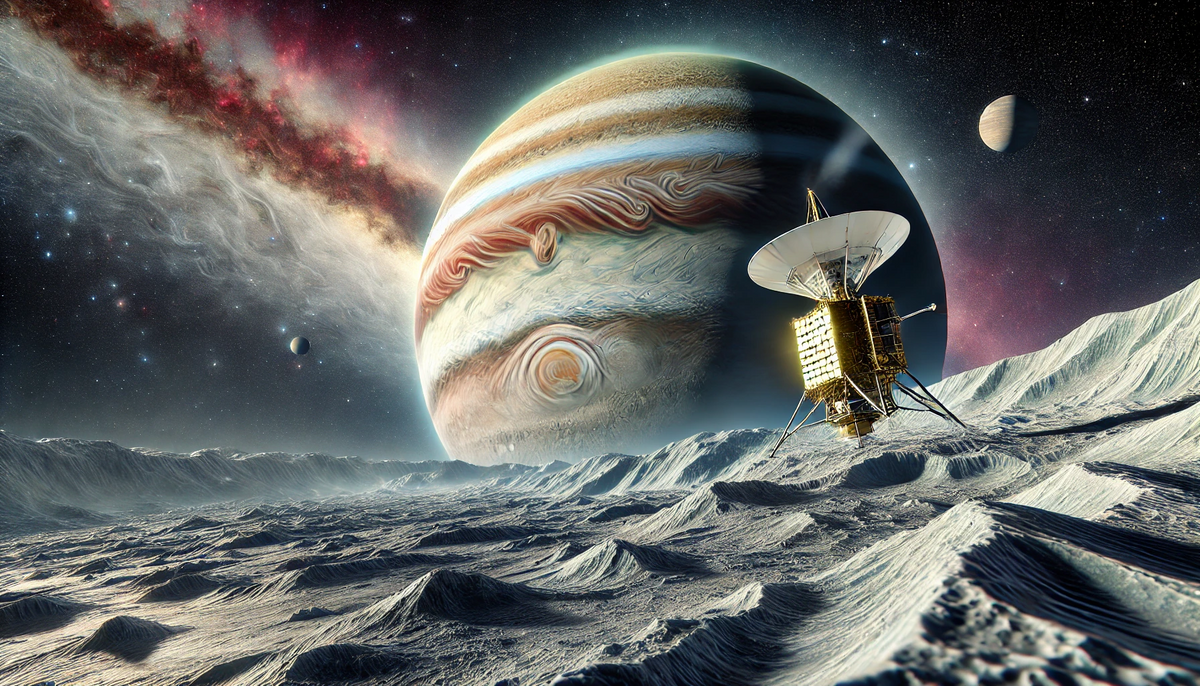
In a mission that has been decades in the making, NASA's Europa Clipper spacecraft represents one of the most ambitious attempts to explore the mysteries of our Solar System. Europa, one of Jupiter’s largest moons, is believed to harbor an immense subsurface ocean beneath its icy crust, sparking fascination about the potential for alien life. By systematically analyzing Europa’s surface and the environment beneath, the Europa Clipper mission aims to provide answers to some of the most profound questions in planetary science and astrobiology.

Image Credit: NASA/Jet Propulsion Laboratory-Caltech, featuring the Europa Clipper spacecraft. Read more about NASA's mission to Europa
Mission Overview
Unveiling the Secrets of the Icy Moon
The Europa Clipper mission involves a journey spanning several years and nearly half a billion miles. Launched in October 2024, the spacecraft is equipped with sophisticated instruments, allowing it to map Europa's surface, analyze its icy crust, and probe beneath for signs of an ocean. The overarching goal is to assess Europa’s habitability, a challenging task given the moon’s extreme environment, high radiation levels, and its distance from Earth. If successful, the mission will reshape our understanding of Europa and could provide a basis for future exploratory missions, including potential landers.

Image Credit: NASA/Jet Propulsion Laboratory-Caltech, illustrating the rugged surface of Europa, one of Jupiter's moons.
Learn more about the challenges of interplanetary missions
Understanding the Gravity Assists
An Essential Journey to Jupiter
The path to Europa isn’t a straightforward trajectory. Instead, Europa Clipper will use a series of gravity assists from both Earth and Mars to gain the speed required to reach Jupiter. This maneuver is not just a fuel-saving strategy but an essential step that allows the spacecraft to conserve resources for its operations once it reaches Europa.
Gravity assists use the gravitational pull of planets to slingshot spacecraft toward their target. With each planetary pass, Europa Clipper gains velocity, shortening its travel time and reducing fuel consumption significantly. These planned assists are set to occur at specific points along its path, making each encounter a critical milestone in the journey to Europa.

Image Credit: NASA/Jet Propulsion Laboratory-Caltech, showing the Europa Clipper spacecraft utilizing gravity assist maneuvers to navigate toward Jupiter.
Read about gravity assists and how they help spacecraft reach distant planets
The Instrument Arsenal
Cutting-Edge Technology Aboard Europa Clipper
Equipped with nine scientific instruments, Europa Clipper is a technological marvel. These tools are specifically designed to investigate Europa’s icy shell, subsurface ocean, and surface composition. Key instruments include the Ice Penetrating Radar (IPR), which will examine the thickness of the ice shell, the Magnetometer for studying the magnetic field interactions, and the Thermal Imager for detecting thermal anomalies potentially linked to geological activity beneath the ice.

Image Credit: NASA/Jet Propulsion Laboratory-Caltech, showcasing the advanced instruments aboard the Europa Clipper spacecraft.
Each instrument contributes to a comprehensive examination of Europa’s surface and subsurface, allowing scientists to measure the depth, salinity, and potential energy sources within the hidden ocean.
Discover more about the instrumentation on board the Europa Clipper
Europa’s Unique Environment
Exploring an Alien Ocean
Europa is an intriguing world where ice and rock meet a suspected vast liquid ocean. This moon’s surface features immense fractures, ridges, and chaotic terrains, hinting at dynamic processes within the ice shell. One of the most exciting theories suggests that geothermal activity on Europa’s ocean floor may create hydrothermal vents, much like those found on Earth’s ocean floors, which could offer a potential habitat for life.
The mission will focus on determining whether Europa’s ocean has the necessary ingredients—liquid water, essential chemicals, and a source of energy—to support simple microbial life. Understanding Europa’s unique environment not only contributes to planetary science but also broadens the scope of astrobiology, allowing us to test hypotheses about life beyond Earth.

Image Credit: NASA/Jet Propulsion Laboratory-Caltech, depicting a conceptual view of Europa's subsurface ocean.
Read about hydrothermal vents and their significance in astrobiology
Flybys of Europa
Gathering Unprecedented Data
Upon arrival at Jupiter, Europa Clipper will orbit the gas giant and conduct a series of 49 close flybys of Europa, each providing a unique opportunity to gather high-resolution images, surface composition data, and environmental measurements. These flybys will allow scientists to analyze Europa’s surface in detail, study its atmospheric composition, and probe its icy crust to unprecedented depths.
Each flyby will provide distinct insights as the spacecraft sweeps over different regions of Europa, ensuring comprehensive coverage of its varied terrain. Through these multiple encounters, scientists aim to collect a wealth of data that can be used to make detailed maps and models of the moon’s structure and oceanic environment.
Explore how flybys contribute to planetary exploration
The Quest for Habitability
What Would Life on Europa Look Like?
If life exists in Europa’s ocean, it would likely be vastly different from anything on Earth. Scientists theorize that Europa’s potential life forms would resemble microbes capable of surviving in extreme environments, similar to extremophiles found near Earth’s hydrothermal vents. These organisms could potentially rely on chemical reactions for energy, known as chemosynthesis, instead of sunlight-driven photosynthesis, which would be absent in Europa's dark ocean.
The search for habitability involves not only detecting signs of water but also identifying organic compounds and energy sources. Scientists will look for plumes—jets of water vapor and other materials venting from beneath the ice, as observed by the Hubble Space Telescope in previous studies. If confirmed, these plumes could offer a window into Europa’s ocean without needing to drill through its ice shell.
Learn about extremophiles and their potential for survival on Europa
Looking Ahead
Paving the Way for Future Missions
The discoveries made by Europa Clipper will set the stage for even more ambitious missions to the icy moon. While a lander mission to Europa would be an extraordinary next step, it would require substantial technological advancements, particularly in landing and drilling technology. The data from Europa Clipper could enable scientists to pinpoint potential landing sites, better understand Europa’s surface conditions, and refine models of its ocean dynamics.
The mission also carries broader implications for humanity’s search for life in the universe. If signs of habitability are found on Europa, it would expand our understanding of the conditions necessary for life, potentially reshaping our place in the cosmos.
Read about future missions to explore icy moons
Conclusion
Europa Clipper’s Legacy
Scheduled to reach Europa in the early 2030s, Europa Clipper represents a monumental achievement in space exploration and a bold step forward in humanity’s quest to explore worlds beyond our own. The data gathered will fuel scientific inquiry for years to come, transforming our understanding of Europa and informing the next generation of planetary exploration missions.
Join the conversation