
NASA's COSI gamma-ray payload arrives for spacecraft integration
Engineers will mount and test the instrument before a planned August 2027 launch. Its detectors trace gamma-ray scattering to reconstruct the high-energy sky.
The scientific payload for NASA's Compton Spectrometer and Imager, or COSI, has arrived at Northrop Grumman's spacecraft manufacturing facility in Sterling, Virginia. NASA reported the delivery on November 16, saying it happened earlier in the month. Engineers will install the instrument on a LEOStar-2 spacecraft and carry out vibration and thermal testing before a launch targeted for August 2027. NASA's delivery update
The move follows assembly of the science instrumentation at the University of California, Berkeley's Space Sciences Laboratory over the summer. It brings the detector and spacecraft work together, while integration, testing and launch remain ahead. The announcement does not give an exact arrival date or report completed environmental tests.
A telescope built around scattered light
Gamma rays carry much more energy than visible light. Rather than focusing them with an ordinary optical mirror, a Compton telescope uses interactions inside a detector. A gamma ray can strike an electron, transfer some energy to it and change direction. The resulting charged particles make the interaction measurable. This process, called Compton scattering, turns a collision into information about the incoming light. NASA's gamma-ray detection guide
Sixteen germanium detectors give COSI three-dimensional positions and energy deposits for interactions. They operate at cryogenic temperatures, with cooling built into the instrument. These measurements allow the team to reconstruct what an incoming gamma ray did inside the detector. COSI's instrument description
From one ring to a source

For a useful event, researchers reconstruct a sequence of interactions. Their geometry and energy deposits constrain the gamma ray's scattering angle. That usually leaves a ring of possible arrival directions on the sky, called an event circle. It does not immediately supply one unique point.
When many photons come from the same source, their compatible event circles overlap. Reconstruction methods use that shared information to build an image. The illustration shows the principle with idealized rings; real measurements have finite uncertainty. Analysis must also identify likely interaction sequences and distinguish celestial signals from background events. How event circles are reconstructed
What COSI is designed to investigate
The telescope is designed to observe gamma rays between 0.2 and 5 million electron volts. This energy range includes signals from atomic nuclei and from the annihilation of electrons with positrons, their antimatter counterparts. Different energy signatures can help researchers map where elements are being produced and investigate energetic sources across the Milky Way and beyond. These are science objectives for the future mission. NASA's mission overview
One target is the 511-kiloelectron-volt emission associated with positron annihilation near the centre of our galaxy. That glow has been known for decades, while the origin of the positrons remains unresolved. Better maps could supply evidence for testing explanations. Delivery of the instrument does not itself resolve that scientific question. NASA's account of COSI's planned measurements
Balloon heritage, followed by a spacecraft

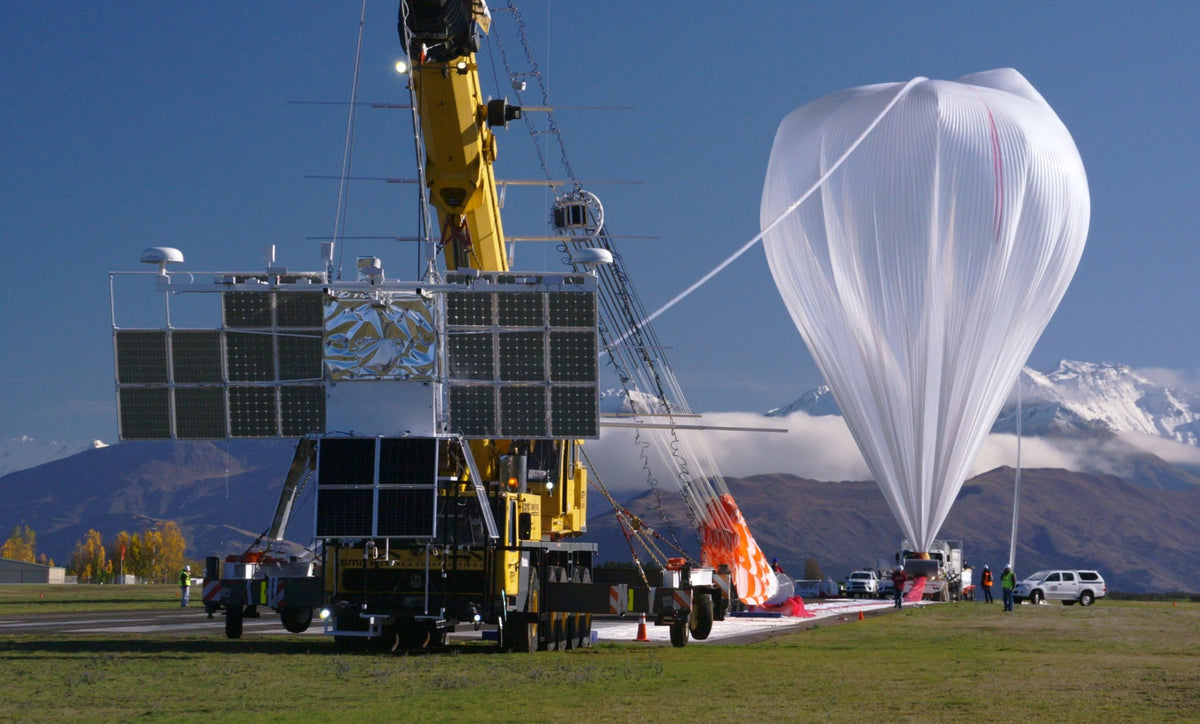
The archival photograph shows the earlier balloon-borne COSI experiment preparing for flight from Wanaka, New Zealand, in 2016. NASA's account identifies the COSI gamma-ray telescope as a science payload carried on that super-pressure balloon. It is a view of the programme's development history, not a photograph of the satellite hardware arriving in Virginia. The 2016 flight account
NASA describes COSI's satellite design as building on technology developed and tested through scientific balloon work. The November delivery is a later step: joining the science instrument to its spacecraft and checking the assembled system. The heritage demonstrates why the concept has a development history; it does not replace the tests required for the space mission.
The next reported milestones should establish what has actually been integrated and tested. For now, NASA has confirmed delivery and described the remaining work, with August 2027 still a launch target rather than a completed flight.
Join the conversation