
NTT and ispace agree to study lunar laser links and power
Feasibility work will examine how light could carry information and deliver electricity. Demonstration plans and lunar performance remain to be established.
NTT and ispace announced on November 16, 2026, that they have signed an agreement to explore Earth–Moon optical communications and laser power delivery on the lunar surface. Initial studies will examine uses, designs, requirements and demonstrations, according to the joint announcement.
The agreement addresses two different needs: moving information and supplying electricity. Both can involve light, but a successful data link does not by itself show that a laser can deliver useful operating power to a lunar machine.
What the partners are proposing
The partners aim to combine NTT's optical research with ispace's lunar transport and mission experience. They plan feasibility studies and possible demonstrations on Earth and in space.
The release announces planning and research. It supplies no deployed network, lunar power test or flight-ready terminal. The immediate development is a joint effort to assess an infrastructure concept.
Carrying data is different from supplying power

In an optical communications link, a transmitter places information onto light and a receiver recovers that information. The end product is a stream of data. NASA's communications overview describes digital information as ones and zeros carried by signals; laser systems use the optical part of the electromagnetic spectrum for the link.
Power beaming has a different objective. Light reaching a suitable photovoltaic receiver is converted into electricity, which equipment can use. NASA's Moonbeam research concept, described in 2021, proposed near-infrared lasers and specially matched photovoltaic devices for flexible lunar power distribution. That earlier proposal is context for the engineering challenge, not a demonstration by NTT or ispace.
The useful result depends on the entire energy path: electricity supplied to the transmitter, conversion into laser light, the fraction reaching the receiver and conversion back into electricity. Those steps introduce losses. A practical system must also manage heat and maintain alignment with its target. NASA's Moonbeam work explicitly included converter efficiency, thermal management and fine pointing among its development tasks.
Laser links already have lunar experience
The new partnership is not the beginning of laser communications at lunar distances. NASA's Lunar Laser Communications Demonstration operated aboard the LADEE spacecraft from October 2013 through April 2014. It demonstrated downlinks from lunar orbit at rates up to 622 megabits per second, using a space terminal and ground terminals on Earth.
That experiment establishes a historical capability under its own conditions. Its best demonstrated data rate is not a promised speed for the NTT–ispace system. Moving from a demonstration to a service also requires decisions about coverage, availability, terminals and operations.
Why the receiving site matters

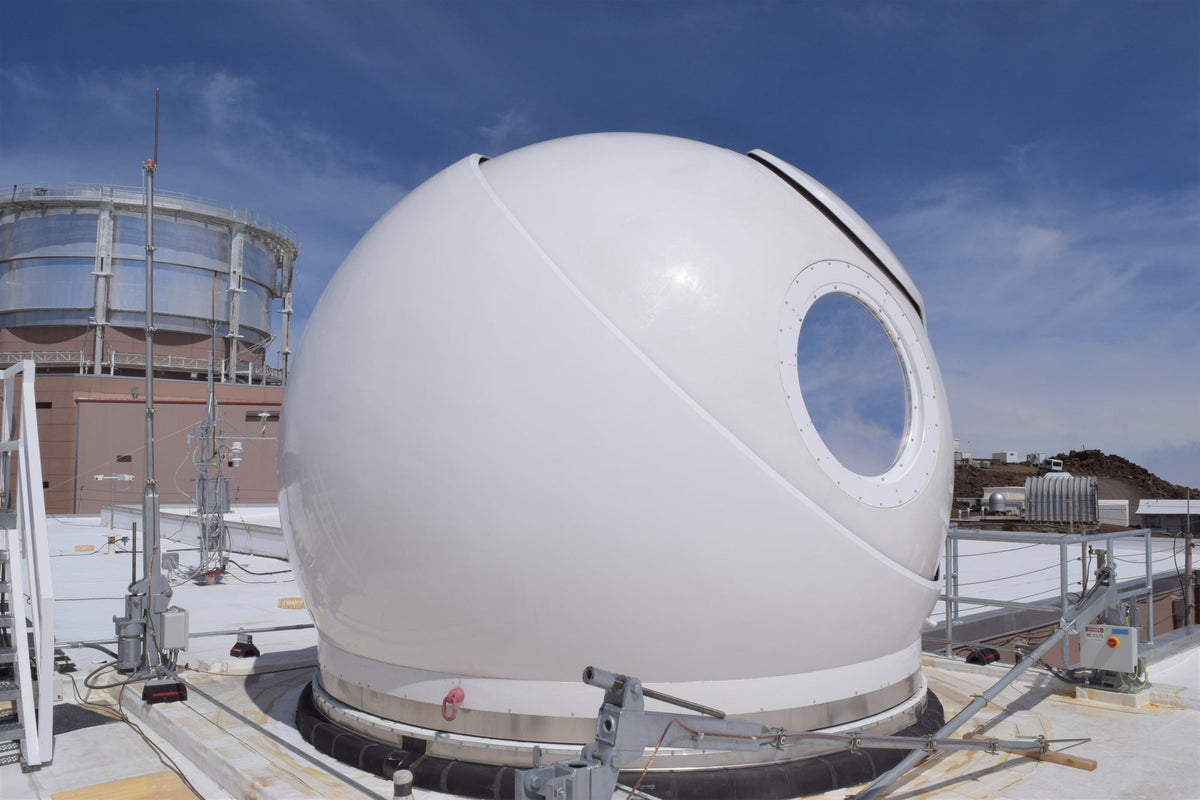
The archival photograph shows NASA's Optical Ground Station 2 in Hawaii, published in 2021. It illustrates real laser-communications ground infrastructure; it is not a facility built under the new Japanese agreement.
NASA's account of its optical ground stations explains why weather and atmospheric conditions influence these links. Clouds can interrupt communications, while turbulence distorts the incoming signal. NASA selected sites in California and Hawaii with complementary weather patterns and used adaptive optics to help correct atmospheric distortion.
These are practical service-design issues, not merely questions of how rapidly a laser can carry bits. A proposed Earth–Moon network needs a plan for the times when a particular path or receiving site is unavailable. The agreement leaves the partners to determine their own architecture and requirements.
What would demonstrate progress
The next evidence to look for is more specific: an agreed test configuration, measured communications performance, delivered electrical power at a receiver, and a demonstration plan with defined conditions. Until those details emerge, the verified development is a collaboration to investigate lunar infrastructure, with the hardware and service performance still to be established.
Join the conversation