
Dragonfly: NASA’s Ambitious Titan Mission
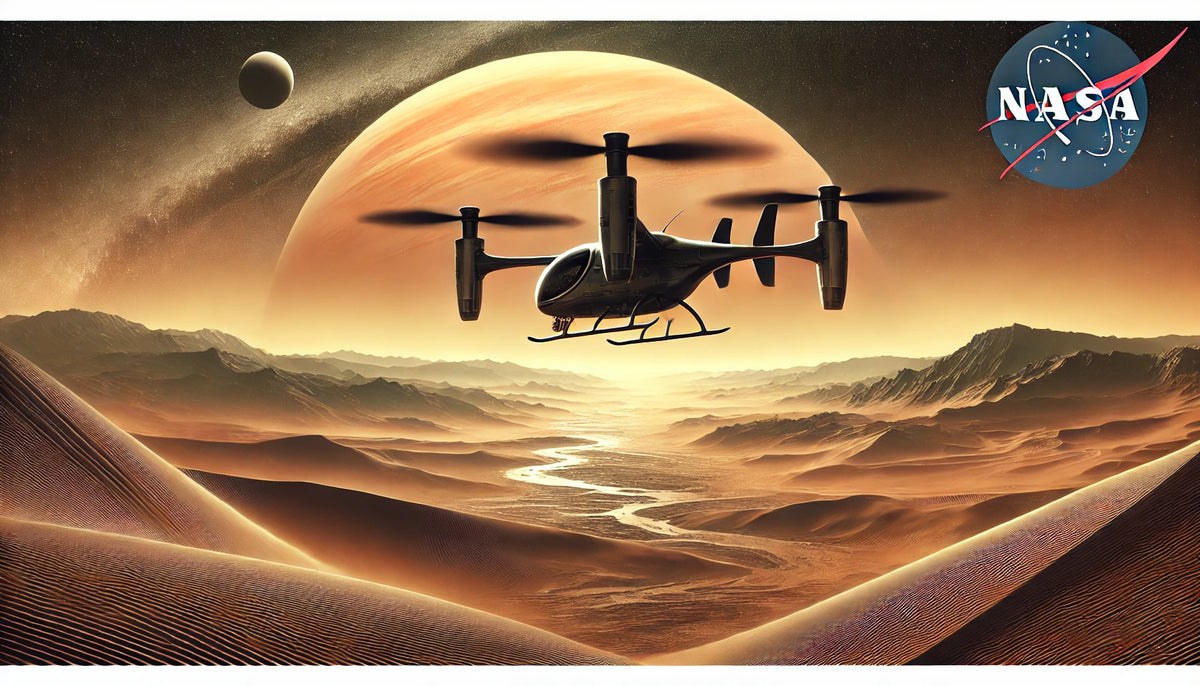
A New Frontier for Space Exploration
By Spaceeve Newsletter Team
Introduction: A Leap into Titan’s Mysteries
NASA’s Dragonfly mission is poised to change how we explore the solar system. Slated for a 2028 launch, this bold endeavor aims to unlock the secrets of Titan, Saturn's largest moon. Titan is an extraordinary world, complete with vast seas of liquid methane, towering dunes, and a thick atmosphere that shields a surface teeming with organic molecules. Unlike traditional rovers or landers, Dragonfly is a rotorcraft designed to fly between multiple sites on Titan, covering terrain that no wheeled vehicle could manage.
The mission is monumental not only in its ambition but also in its technological innovation. Dragonfly is set to be the first flying probe to explore another world, hopping from location to location as it studies Titan’s rich atmosphere and geological features. For space enthusiasts and scientists alike, the mission marks a critical chapter in our understanding of both planetary science and the potential for life beyond Earth.
The Science of Titan: A World Like No Other
Titan, with its methane lakes and nitrogen-rich atmosphere, is often described as an analog to early Earth. While its surface is extremely cold (around -179 degrees Celsius), it has a thick atmosphere—about 1.5 times denser than Earth’s—which allows for the formation of clouds and rain. This makes Titan the only body other than Earth known to have stable liquid on its surface. However, instead of water, Titan’s rivers and lakes are filled with liquid methane and ethane.
This unique environment, coupled with the possibility of a subsurface ocean of liquid water, makes Titan one of the most exciting targets for astrobiological studies. By exploring various sites across Titan, Dragonfly will study how far prebiotic chemistry—the chemistry that can lead to the formation of life—has progressed. Its findings could offer new insights into the early conditions that may have led to life on Earth.
The Technology: Engineering the Dragonfly Rotorcraft
Dragonfly’s technological design is groundbreaking. As an octocopter, it features eight rotors that give it the ability to fly across Titan’s varied landscape. This innovative rotorcraft design allows Dragonfly to land, take off, and hover like a drone, offering unprecedented mobility. Its flight system is complemented by artificial intelligence, allowing the craft to navigate autonomously, as real-time control from Earth is impossible due to the long communication delay.

One of the mission’s most important features is its power source. Dragonfly will use a Multi-Mission Radioisotope Thermoelectric Generator (MMRTG), the same type of nuclear battery that powers the Mars Curiosity rover. This reliable energy source allows the rotorcraft to remain operational through Titan’s long, dark nights, where temperatures can plunge far below freezing. The MMRTG generates electricity from the heat produced by the radioactive decay of plutonium, making it ideal for powering missions on distant, cold worlds like Titan.
Additionally, Dragonfly’s design takes advantage of Titan’s dense atmosphere, which is four times denser than Earth’s. This dense atmosphere makes powered flight much more efficient, allowing the rotorcraft to travel at approximately 36 km/h and reach altitudes of up to 4 kilometers. These flights will allow Dragonfly to explore multiple locations, from dunes to potential cryovolcanoes, where it can search for chemical markers of life.
The Process: How Dragonfly Will Explore Titan
Once Dragonfly lands on Titan in 2034, it will begin a multi-year mission to explore diverse locations across the moon’s surface. The mission is structured to allow Dragonfly to hop between various geological sites, traveling several kilometers in a single flight. Each site will be chosen based on its potential to reveal key scientific information about Titan’s chemistry, atmosphere, and possible life-supporting environments.
One of the primary areas of interest is Titan’s equatorial dune fields, believed to be rich in complex organic molecules. These fields may hold clues about how prebiotic chemistry evolves in an environment rich in carbon compounds. Dragonfly will also explore impact craters, which are prime locations for studying how Titan’s surface materials interact with external forces, such as impacts from asteroids or comets.
Each flight will last about an hour, covering several kilometers before Dragonfly lands to conduct more detailed surface analyses. By exploring diverse geological sites, the mission will give scientists a comprehensive view of Titan's dynamic environment and help answer key questions about the moon’s potential habitability.
Why It Matters: The Astrobiological Hunt for Life
Titan is one of the most promising locations in the solar system for discovering extraterrestrial life. Its thick atmosphere contains large amounts of organic molecules, which are the building blocks of life as we know it. The possibility of a subsurface ocean also raises the exciting prospect that life, if it exists on Titan, could be supported by water-based chemistry beneath the icy crust.
Dragonfly’s mission is to investigate whether Titan has the right conditions for life. Specifically, it will search for biosignatures—chemical markers that indicate the presence of life—by analyzing samples of surface materials and studying their interactions with Titan’s atmosphere. The mission also aims to understand how organic materials on Titan might have evolved over time, offering new insights into how life could emerge on planets and moons throughout the universe.
What We Hope to Find: The Future of Space Exploration
The potential discoveries from Dragonfly are vast. If it finds signs of life, even in its simplest forms, it will be one of the most profound discoveries in the history of science. Such a finding would suggest that life is not unique to Earth and could exist in many different environments throughout the universe. Even if Dragonfly does not find direct evidence of life, its data will offer valuable insights into the planetary processes that shape Titan and other icy moons like it.
In addition, the mission will provide essential information for future exploration. As humanity looks to expand its reach beyond Earth, understanding the conditions on Titan could help us better prepare for missions to other planets and moons. By studying Titan’s methane cycle, weather patterns, and surface composition, Dragonfly will lay the groundwork for future missions that could one day explore Titan in even greater detail.
For now, we look forward to the launch in 2028 and the wealth of knowledge that Dragonfly will bring back to Earth by the mid-2030s. This mission is a key step in our journey to explore the outer solar system, and its findings could reshape our understanding of life’s potential beyond Earth.
Sources:
- NASA. "Dragonfly: NASA’s Rotorcraft Lander Mission to Titan." NASA Science .
- Wikipedia. "Dragonfly (Titan space probe)." Wikipedia .
Join the conversation