
Moore's Law Meets Space Exploration

A graph showing the annual number of satellites launched into space (red) plotted against a dashed line illustrating biennial doubling (blue). Credit: Edward Lu
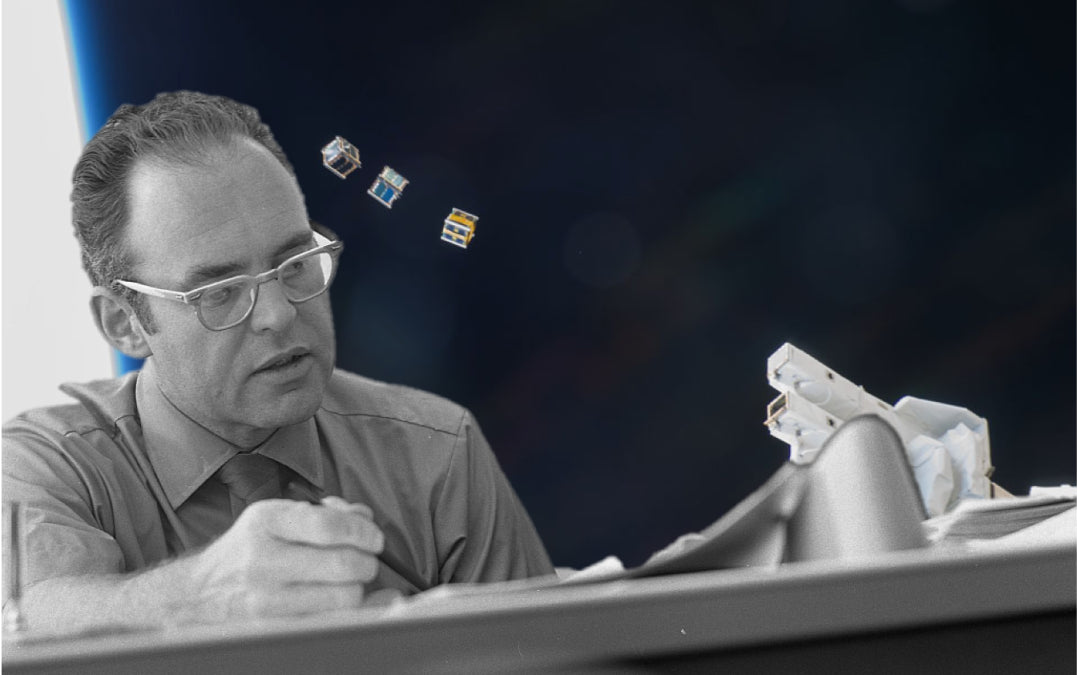
Over the past few decades, a seismic shift has occurred in the realm of space exploration. An unprecedented surge in spacecraft launches, doubling every two years since 2015, has set the stage for a potential revolution in space activities. Drawing parallels with Moore's Law, the exponential growth of transistors on integrated circuits, this exponential trend in space could reshape our society, economy, and way of life.
The Lunar Connection: A Glimpse into the Future
As we witness this exponential rise, the moon emerges as a revolutionary platform for cutting-edge telescopes. The International Astronomical Union (IAU), in collaboration with the United Nations, is taking strides to establish policies and global agreements, ensuring the protection of lunar astronomical endeavors from potential interference caused by burgeoning lunar activities.
Space Odyssey: The SpaceX Factor
Much of this surge is attributed to the prowess of SpaceX, launching rockets at an unprecedented rate. However, as we reflect on the ever-changing landscape of technological dominance, questions arise about the longevity of SpaceX's lead. Will the space industry witness a shift akin to the dynamic changes seen in the technology sector?
The Technological Tapestry: Moore's Law for Space
Technological progress stemming from Moore's Law has played a pivotal role in this space exploration boom. The miniaturization of spacecraft components, driven by advancements in aerospace technology, has allowed launches carrying up to 100 satellites at once. Yet, the exponential growth in both spacecraft and computing power is not solely a result of technical advancements.
Economics and Expectations: Catalysts of Exponential Growth
Economic factors, growing demand, and increasing expectations fuel this exponential growth in spacecraft launches. With lowered launch costs, new business plans become viable, leading to a surge in critical space services such as communications and Earth monitoring. As companies strive to meet the expectations set by Moore's Law, the growth becomes a self-fulfilling prophecy.
Space Traffic Jam: Challenges on the Horizon
However, with great progress comes great challenges. If the launch rate of spacecraft continues to double every two years, the issue of space debris could escalate. Collisions in space, exacerbated by an increasing number of satellites, pose a threat to both active satellites and astronauts aboard the International Space Station. Solutions must address the growing reality of space traffic.

LEO objects including satellites, other spacecraft, and debris, tracked by LeoLabs. Credit: LeoLabs
Security Concerns: Navigating a Complex Cosmos
An exponential growth in space traffic also amplifies security issues. Military conflicts involving attempts to neutralize satellites become more likely, and the number of satellites with hidden military threats rises. As space technology extends beyond traditional players, new entrants bring increased chances for mischief, requiring robust monitoring systems.
Astronomy in Peril: Impact on Ground-Based Telescopes
Even ground-based telescopes face challenges. The proliferation of satellites in low Earth orbit could impede astronomical observations, affecting scientific studies. As satellite constellations grow larger, operators may need to make accommodations, such as flying constellations at lower altitudes, to mitigate the impact on sky observations.
Regulating the Cosmos: The Need for Standards
The exponential growth in space activities calls for greater regulation. Verifiable standards for preventing space debris and coordinating orbits to prevent collisions become imperative. These regulations must be designed to accommodate the repeated doublings of space traffic on short timescales.
Preparing for the Future: Adapting to Moore's Law for Space
In light of Moore's Law for Space, stakeholders in space-related ventures must evaluate how their plans align with this rapid evolution. The winners in this dynamic landscape will leverage rapid development timescales to outpace their competition, fostering innovation and adaptability.

Looking Ahead: The Potential of a Growing Space Economy
As we contemplate the exponential growth in space activities, a burgeoning space economy emerges. Commercial companies anticipate significant growth in services and profits provided through space. Investors stand to benefit from exponentially growing opportunities, and engineering talent is likely to follow suit, sparking a continuous feedback loop of progress.

Conclusion
Just as Moore's Law has transformed our lives over the past six decades, Moore's Law for Space holds the potential to shape the next 60 years. This exponential growth signifies more than just an increase in satellite launches; it heralds a new era of human expansion into space, scientific discoveries, and flourishing markets. The space economy has the power to generate jobs, wealth, and improvements in our lives on Earth. As we navigate this exponential trajectory, the cosmos beckons us to explore the vast potential it holds.
Join Space Eve Blog in the exploration of the cosmos and share your passion for space! Have a news tip, correction, or comment? We welcome your input! Feel free to reach out to us at support@spaceve.com. Your contributions help us keep the space community informed and connected.
Join the conversation