
Perseverance Found Its First Meteorite on Mars
PERSEVERANCE ROVER MAY HAVE FOUND ITS FIRST

NASA Mars Perseverance Mastcam-Z PIA26511)
A Striking Metallic Boulder in Jezero Crater
NASA’s Perseverance rover may have identified its first potential meteorite on Mars — a tall, metallic, unusually smooth boulder photographed on Sol 1612.
The object, now informally known as “Phippsaksla,” stands out sharply from the surrounding terrain, which is mostly composed of flat, eroded sedimentary rocks formed in the ancient lakebed of Jezero Crater.
Unlike typical Martian rocks that weather into fractured, dusty fragments, this one appears:
-
taller than the surrounding stones
-
smoother, with curved surfaces
-
metallic, reflecting more light than native rocks
-
isolated, with no obvious connection to nearby geologic layers
These features immediately raised the possibility that Phippsaksla did not form on Mars at all.

NASA Mastcam-Z close-up Sol 1612 photo)
Laser Tests Reveal Iron and Nickel — Classic Meteorite Chemistry
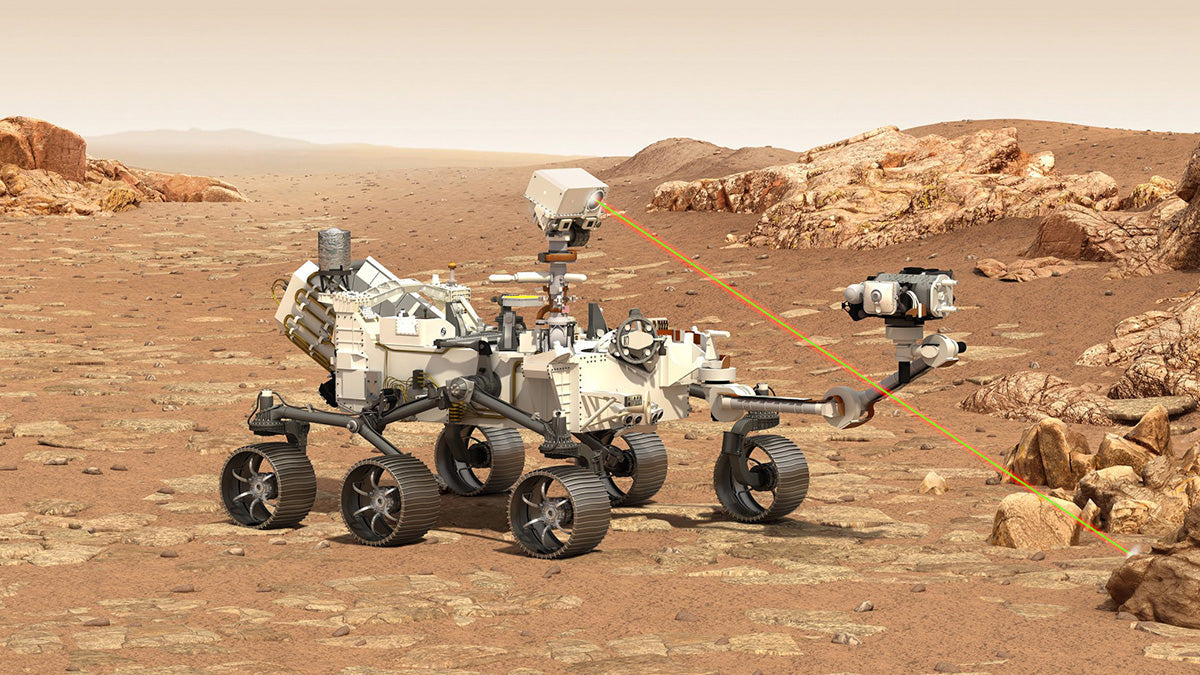
To investigate the rock, mission scientists used SuperCam, the rover’s laser spectroscopy instrument.
SuperCam fires rapid pulses at a target, vaporizing microscopic amounts of material and reading the resulting light to determine chemical signatures.
In the case of Phippsaksla, the laser results showed:
-
elevated iron content
-
detectable nickel
This combination is characteristic of iron–nickel meteorites — metallic fragments that come from the cores of differentiated asteroids.
On Earth, iron meteorites are well-known for their stability and resistance to weathering. On Mars, with its thinner atmosphere and lower oxidation rates, such meteorites can survive for millions of years in relatively good condition.
If confirmed, Phippsaksla would not be a native Martian boulder but a cosmic visitor delivered to Jezero Crater long before Perseverance arrived.
Why Meteorites Matter on Mars
Iron meteorites found on Mars offer unique scientific value:
They preserve early Solar System material
These rocks formed in the molten cores of ancient asteroids that broke apart billions of years ago.
They record impact events
Finding a meteorite helps scientists understand how often Mars is struck by asteroidal debris — especially since its thin atmosphere allows many metallic objects to survive entry intact.
They act as “control samples”
Compared to complex sedimentary rocks formed by water, a meteorite provides a simpler, well-understood reference point for the rover’s instruments.
They weather differently
Studying how metal weathers over time in the Martian environment provides clues about climate, exposure, and soil chemistry.
Previous rovers — including Opportunity and Curiosity — have discovered several iron meteorites. Phippsaksla would be Perseverance’s first.
A Bonus Discovery During a Life-Hunting Mission
Perseverance is exploring Jezero Crater to answer one profound question:
Did Mars once host microbial life?
The rover’s primary tasks include:
-
analyzing ancient lake deposits
-
drilling and caching core samples
-
studying the river delta where water once flowed
-
preparing samples for future return to Earth
Meteorite hunting is not part of the mission’s core objectives.
Yet finds like Phippsaksla enrich the scientific value of the mission by providing additional data about planetary history, impact processes, and material weathering.
What Comes Next
At the moment, Phippsaksla remains a candidate meteorite.
Confirming its true nature requires continued analysis — including:
-
more laser spectroscopy
-
multispectral imaging
-
possible comparison with other isolated rocks in the area
Regardless of the final classification, this striking object has already become one of the most intriguing geological finds of Perseverance’s journey so far.
It serves as a reminder that even while searching for ancient biosignatures, a rover on Mars can still stumble upon an object forged in some of the earliest moments of our Solar System’s formation.
Join the conversation