
THE 'DEVIL COMET' IS HEADED OUR WAY!
Introduction
Comets, those enigmatic wanderers of the night sky, have captivated human imagination for centuries. Among them, Comet 12P/Pons-Brooks, affectionately dubbed the "Devil Comet," has recently made headlines with its intriguing behavior. But what lies behind this sensationalized moniker, and what can we learn from this cosmic visitor? Let's delve into the fascinating world of comets and uncover the truth about the Devil Comet.

Comet Pons-Brooks underwent a second outburst in early October 2023, once again developing "horns," as captured here while it was in Draco. Credit: Chris Schur
The Legend of Comet 12P/Pons-Brooks
Comet 12P/Pons-Brooks, though commonly referred to as the Devil Comet, carries a much less ominous name in astronomical circles. This short-period comet, orbiting the Sun once every 71.2 years, shares similarities with the renowned Halley's Comet. Its discovery dates back to 1812, when comet hunter Jean-Louis Pons first observed it, but precise predictions of its return eluded astronomers until William Brooks rediscovered it in 1883. Modern research suggests the comet may have been recorded in historical records as far back as 1385, adding to its mystique.
Unraveling the Devil's Secrets
Estimating the size of a comet poses challenges, but recent studies suggest that Comet Pons-Brooks boasts a nucleus approximately 10.5 miles (17 km) in diameter – larger than Mount Everest. Despite uncertainties surrounding this measurement, the comet's remarkable size commands attention. Its recent outbursts, causing dramatic brightening and horn-like formations in its coma, have only added to its allure. While the exact cause of these outbursts remains a subject of debate among astronomers, their occurrence underscores the dynamic nature of cometary activity.
Dispelling Misconceptions
Contrary to its ominous nickname, the Devil Comet poses no threat to Earth. Despite its close approach to the inner solar system, the comet's highly inclined orbit ensures it remains safely distant from our planet's orbit. As it journeys through space, it will pass between the orbits of Earth and Venus, never crossing our own path. Therefore, fears of potential impact are unfounded, offering reassurance to skywatchers worldwide.

Pons-Brooks is on a highly inclined orbit that will bring it down from above the plane of the planets. It will pass through the inner solar system between the orbits of Earth and Venus, never crossing our own planet’s orbit. Credit: TheSkyLive.com 3D Solar System Viewer, Background Image: ESO/S. Brunie
Anticipating a Celestial Spectacle
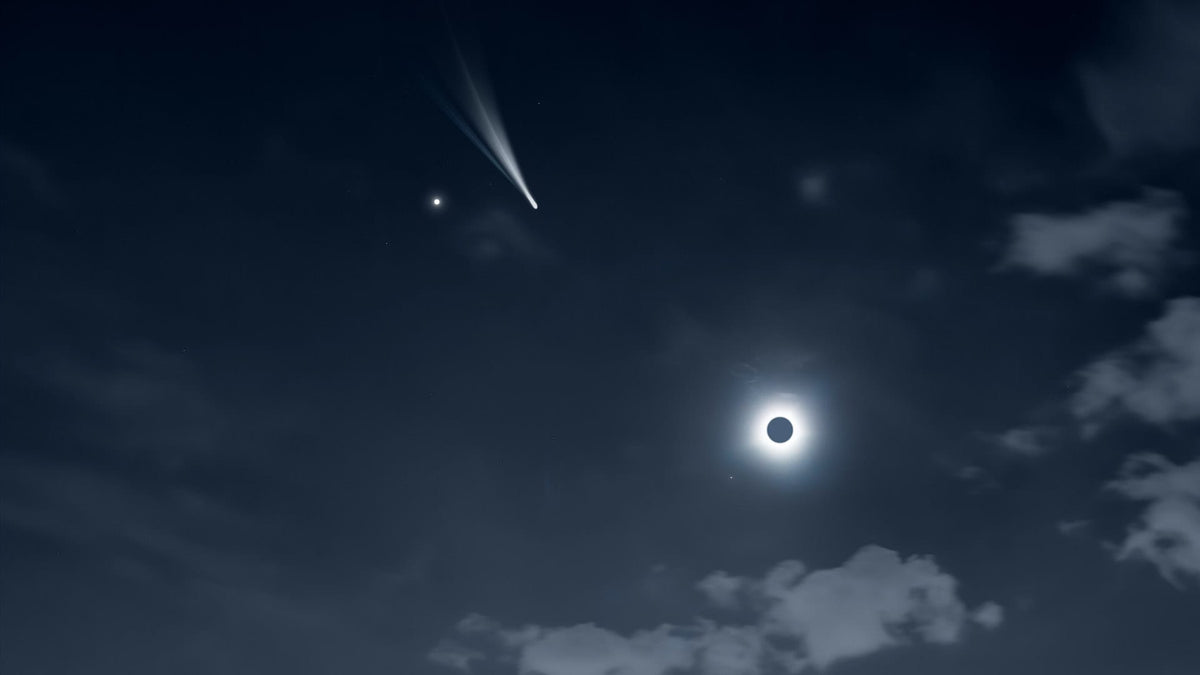
One highlight of Comet Pons-Brooks' journey will coincide with a rare astronomical event – a total solar eclipse. Scheduled to occur just two weeks after the eclipse, the comet's proximity to the Sun during totality promises a captivating sight for observers. With the potential for visibility even during daylight hours, this celestial convergence presents a unique opportunity for astronomers and sky enthusiasts alike.
Conclusion
As the Devil Comet graces our skies, it serves as a reminder of the wonders and mysteries of the cosmos. Beyond its sensationalized nickname lies a celestial phenomenon rich in scientific intrigue and beauty.
By studying comets like Pons-Brooks, we gain invaluable insights into the origins and dynamics of our solar system. So, when you gaze upon the night sky and hear whispers of the Devil Comet, remember – it's not a harbinger of doom, but a harbinger of discovery and wonder.

Join Space Eve Blog in the exploration of the cosmos and share your passion for space! Have a news tip, correction, or comment? We welcome your input! Feel free to reach out to us at support@spaceve.com. Your contributions help us keep the space community informed and connected.
Join the conversation