
Curiosity catches Mars clouds still glowing after sunset
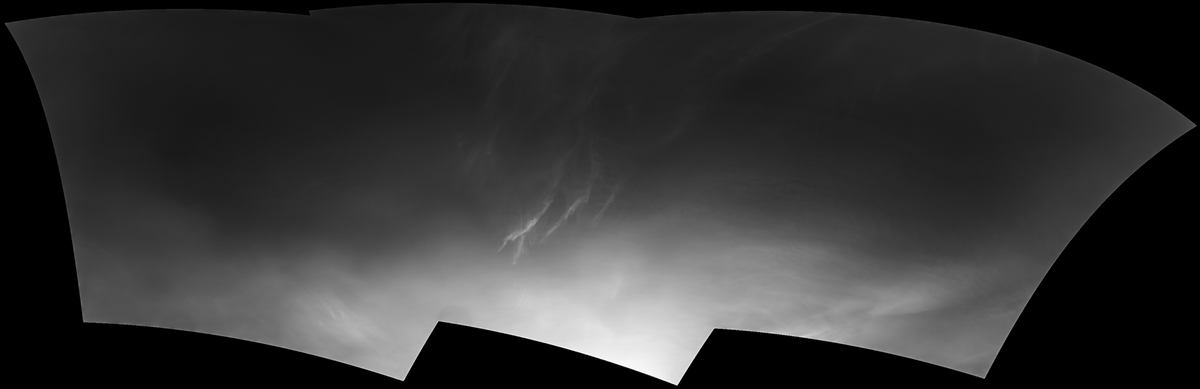
Newly released views show twilight clouds above Gale Crater on October 31. Their glow reveals sunlight reaching the atmosphere after the ground has entered shadow.
NASA has released a new view of clouds moving across the evening sky above Gale Crater on Mars. Curiosity recorded the sequence on October 31, 2026, its 5,061st Martian day. The Photojournal release added November 20 identifies the observations as navigation-camera images of twilight clouds. The pictures document an October observation, rather than a cloud event happening on the release date.
Sunlight above a darkening surface

Twilight clouds remain illuminated after sunset because they stand high enough to receive sunlight over the planet’s curved horizon. The ground below can already be in shadow while light still reaches the ice particles overhead. As JPL explained in 2021, their brightness is reflected sunlight, rather than the clouds producing their own light. As Mars turns, the planet’s shadow climbs through the atmosphere and eventually removes that illumination.
The distinction matters when interpreting the image: a bright cloud against a dark sky is evidence about lighting geometry. Brightness alone does not identify the ice or give its height.
How earlier observations measured cloud height
A 2024 study led by Mark Lemmon used the timing of that moving shadow to estimate the altitude of clouds seen in earlier Curiosity campaigns. Its cirrus-like clouds were about 50–80 kilometers high and probably contained carbon dioxide ice; lower, wave-shaped layers may have contained water ice. Those are findings from earlier observations, not measurements of the newly released October 31 clouds.
The same study used color variations to investigate particle sizes. Particles with a narrow range of sizes can diffract light into distinct colors; a broad mixture tends to wash those patterns out. The new navigation-camera sequence is black and white, so it does not provide that color diagnostic.
A seasonal opportunity to study the atmosphere
NASA says these post-sunset clouds appear during a short fall season over Gale Crater. In its February 2025 account of a separate cloud campaign, the agency described how the recurring season lets researchers plan observations ahead of time. Repeated sightings help scientists investigate how ice particles form and grow in Mars’ thin atmosphere.
Some high clouds on Mars contain frozen carbon dioxide, while other clouds contain water ice. Scientists have considered atmospheric gravity waves as a possible cooling mechanism for carbon dioxide clouds near Gale. These waves are oscillations in the atmosphere, distinct from gravitational waves in spacetime; their role in producing the local cloud pattern remains uncertain.
What this release establishes
The eight-frame sequence shows changing wisps across the rover’s view. Its release caption supplies the date and camera type, but no elapsed recording time, wind speed, cloud-height measurement or composition result for this observation. We therefore show an unchanged still from the sequence and link to NASA’s original animation, without assigning a motion speed or borrowing the older study’s altitude as a new measurement.
Join the conversation